
Where Reliable Sofa Quality Really Comes From

If you’re an independent furniture retailer asking, "What should I ask before trusting a new sofa supplier?"
— start by changing the frame. Don’t treat quality as a checkbox or a single factory attribute. Treat it as the product of three linked capabilities: the materials you’ll get, the structure behind the design, and the production process that turns plans into repeatable outcomes. Those three things, combined with how a supplier handles feedback and small-batch demand, determine whether the partnership protects your customer experience and your store’s long-term value.
Below I’ll walk through what each capability looks like in practice, what you should ask suppliers, and how a platform cooperation mechanism backed by real factory capability like StarbornHub ties the pieces together so you can actually rely on local demand and customer response — not just promises.
Three real sources of sofa quality
Quality isn’t one number. It’s an outcome that emerges when three areas are controlled together:
- Materials: fabrics, foam, wood frames, and metal hardware form the physical foundation. They determine touch, initial comfort, resilience, and obvious failure modes (tears, sagging, squeaks).
- Structure design: this is the engineering behind the sitting experience — how forces are distributed, where reinforcements go, how modular components join. Different structure choices with the same raw materials can produce drastically different durability and maintenance profiles.
- Production process: cutting, sewing, joinery, assembly, and final inspection turn raw inputs into consistent finished products. Weakness here amplifies any material or design shortcoming; strong process control can make a good design consistently good for customers.
A retailer’s job is to evaluate those three, not to guess quality from a factory’s size or glossy brochure.
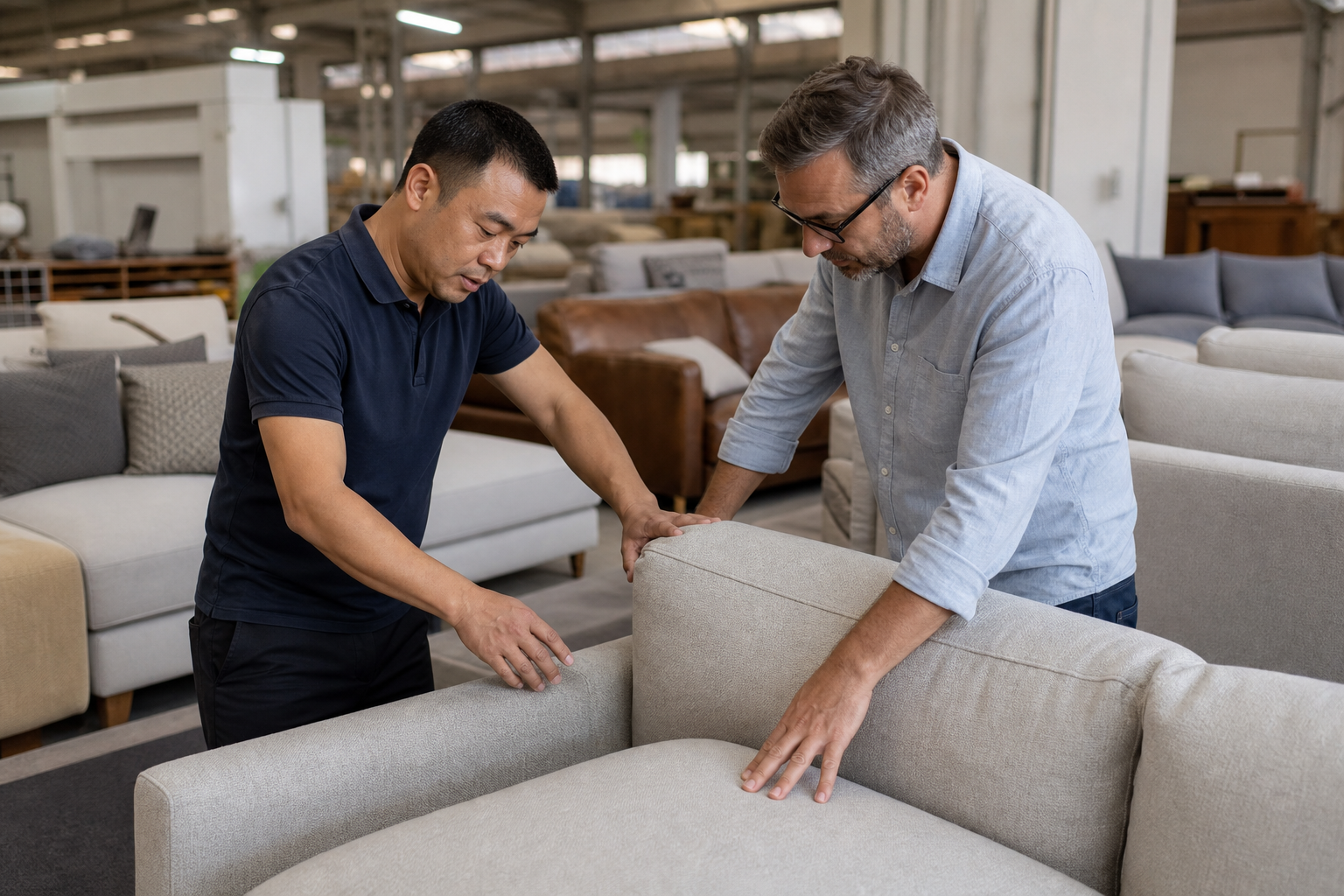
Why factory size alone doesn’t answer the question
I often hear retailers equate large factories with better quality and small shops with risk. That’s an oversimplification. Large factories bring strengths: standardized processes, defined workstations, and inspection routines that support consistency on repeat orders. Smaller workshops bring a different advantage: flexibility. They can iterate faster on samples, handle bespoke requests, and pivot for local tastes or small-batch experiments.
Neither is universally superior. The smart choice is using each for what they’re best at: stable, repeatable lines for core SKUs; flexible shops for local variations, small test runs, and quick sample cycles. A promising supplier strategy recognizes this and has mechanisms to combine both strengths — stability where you need it, flexibility where you want to experiment.
Practical questions to ask a prospective supplier
When you sit down with a new supplier, the conversation should focus on how they manage the three quality sources and how they connect product outcomes back to your store. Here’s a checklist you can use:
- Material traceability: Can they describe how basic materials are selected and traced? Who approves substitutes and how are material changes communicated? Look for documented policies rather than verbal assurances.
- Design verification: How are structure designs validated before full production? Ask for evidence of prototype testing, durability checks, and how design notes translate into assembly instructions.
- Production controls: What checks exist at critical process participation history (cutting, sewing, frame assembly, final inspection)? Can they show examples of their inspection records or QC steps for similar lines?
- Sample and small-batch capability: How quickly can they produce a small run or alternate fabric combination? Do they have defined minimums and a sensible workflow for rapid iterations?
- After-sales linkage: How do they collect and act on returns, repairs, and customer feedback? Are those inputs visible to designers or production planners?
- Local-market sensitivity: Can they support localized preferences without breaking the quality baseline? For example, can they run a local sample pool for your store and react to what buyers tell you?
- Accountability and traceability: If a problem arises, can they trace it to a batch, material lot, or process step? That’s the difference between one-off fixes and system-level correction.
These questions focus the supplier conversation on capabilities you can verify, rather than vague promises about "good quality."
How a open platform backed by real manufacturing capability changes the dynamics
A platform cooperation mechanism backed by real factory capability like StarbornHub doesn’t pretend to solve quality by fiat. It makes a practical commitment: build a unified quality baseline that covers materials, design verification, production controls, and feedback loops — and run that baseline through owned factories first so you can iterate and prove the system.
What that looks like in practice:
- A clear materials admission and traceability process so you and your supplier are aligned on what arrives at the line.
- Design verification tied to prototyping and durability checks, so structure isn’t a guess once you put it on the showroom.
- Embedded production checkpoints and sampling protocols so the same SKU is consistent across lots.
- A feedback connection that routes returns and customer notes back to development and procurement teams for improvements.
That doesn’t mean StarbornHub hides operations behind brand language. It means the platform can pilot rules in its own factories, learn where inspection participation history matter most, and then fold those practices into partnerships — all while keeping traceability and quality baselines intact. For a retailer, this lowers the risk of “we’ll figure it out after launch” because the launch itself has already been refined against real manufacturing constraints.

Turning quality into a retail asset, not a sunk cost
Treat consistent quality as something that builds value over time. When your customers get reliable products, you reduce returns, increase repeat purchases, and make your store’s brand stronger. That’s the business logic: quality lowers friction and increases asset value — account value, word-of-mouth, and long-term revenue — more than a one-time margin improvement.
To make that work, quality control must be linked to flexible supply operations. If customers in your market prefer a particular fabric or slightly different cushion feel, your supply chain must support small trials and quick replenishment without losing the quality baseline. That means the production side needs pre-aligned inspection standards, a materials pool that supports common substitutions without surprise, and the ability to run controlled small batches.
When the supply side and feedback loops are connected, local customer response becomes a practical buying signal. It stops being decoration around the sale and becomes an input to planning. That’s the difference between chasing fads and systematically growing a catalog that suits your neighborhood.

What to expect from a reliable partnership model
Not every supplier will operate like a platform, and that’s fine. What you should expect are clear behaviors:
- Transparent material and process standards you can reference when discussing returns or product questions.
- Demonstrable sample processes and small-batch runs that show how the supplier can respond to your local taste.
- A feedback mechanism that links after-sales data back to the people who make procurement and design decisions.
- A willingness to treat quality as part of your store’s long-term performance — not just a line item on an order form.
If a supplier resists making these behaviors explicit, you’re accepting more risk. If they already do these things, you have a partner who treats quality as an asset that supports your retail business.
A short checklist you can use today
- Ask for a materials admission and substitution policy in writing.
- Request evidence of structure testing or prototype validation on comparable models.
- See the supplier’s production checkpoint descriptions and how they handle final inspection.
- Confirm small-batch and sample lead times and how those runs are controlled to the same quality baseline as larger lots.
- Define how returns and customer feedback are recorded and routed to design or procurement teams.
Use these items in supplier conversations and in contract language so you’re not later negotiating quality in the middle of a customer complaint.
Conclusion
Sofa quality isn’t decided by a factory’s footprint alone. It’s the product of materials, structure design, and production process — and it becomes valuable to your store only when those elements are tied to a reliable feedback and supply mechanism. A platform-led cooperation backed by real factory capability model like StarbornHub helps by piloting unified quality baselines in owned factories, connecting after-sales signals back into design and procurement, and enabling flexible small-batch supply without sacrificing consistency. For independent retailers, the practical takeaway is simple: vet suppliers on those capabilities, insist on traceability and feedback loops, and treat quality as an asset that compounds over time rather than a one-off cost.
More articles in this content module
Module: Supplier Trust And Quality Responsibility
This is the full reading map for the current content block, so you can follow the logic inside this topic before jumping to another issue.
- Quality Consistency Needs A Visible Process?
- Fabric Choice And Custom Options Need Control?
- Wholesalers Struggle To Build This Mechanism?
- Large Factories Usually Avoid Retailer-Led Validation
- Smaller Factories Can Support Flexible Retailer Cooperation?
- Why Chinese Small & Mid-Sized Sofa Factories Work Better for Flexible Retail Partners
- Where Reliable Sofa Quality Really Comes From
- China Supply Chain Should Not Be Overpromised?
- Sofa Repair and Claim Options?
- First-Order Trust Connects With Quality Control?
- Two Similar Furniture Stores Can Become Different Over Time?
- StarbornHub Starts From A Real Factory Base?
- Roger's Factory Background Matters?
- StarbornHub Does Not Replace Independent Retailers?
- What should a furniture retailer ask before trusting a new sofa supplier?
Other content modules you may want to explore
If your concern is not only this one issue, these modules open nearby paths in the StarbornHub theory system.
Another problem retailers often connect to this: A nearby visible problem you may also be dealing with
Is the sales drop caused by fewer visitors, lower conversion, weaker product fit, local market pressure, or broader economic pressure?
First reading in this module: What changed in the furniture retail market?
What this could improve if handled better: A possible business gain behind this issue
Traffic And Conversion Diagnosis
Is the store missing traffic, or is the existing traffic not converting?
First reading in this module: What is the operating formula behind an independent furniture store?
What it may take, cost, or risk: The practical concern before trying a new path
Slow-Moving Inventory Diagnosis
Is the slow item still earning its cash, floor space, and selling attention?
First reading in this module: Why is slow-moving inventory more than an inventory problem?