
Why Chinese Small & Mid-Sized Sofa Factories Work Better for Flexible Retail Partners

Independent furniture retailers often face unclear local demand, uncertain local taste signals, and uneven buyer confidence.
If you want to give customers more choice without carrying huge inventory risk, you need suppliers that can run many SKUs in small batches, respond quickly, and cooperate with a feedback-driven selling model. That combination is not just a product of low labor cost — it’s a function of supply-chain completeness, production experience, and a willingness to rebuild the selling mechanism. That’s why, in practice, Chinese small and mid-sized sofa factories tend to be better fits for this model than many European counterparts.
Below I explain the business logic, the practical implications for a retailer evaluating a new sofa supplier, and the exact questions you should ask before trusting them.

What’s different in China’s small and mid-sized factories
There are four practical reasons this supplier model tends to work in China more often than in Europe:
- Motivations: Many European small factories already rely on steady batch orders from established wholesalers, brands, or local high-end clients. Rebuilding production and commercial practices to accept many small, variable orders is complex and often unnecessary. By contrast, many Chinese factories live in a more competitive, export-driven environment where adapting to multiple small buyers is part of survival.
- Cost and pricing dynamics: European manufacturing faces higher energy, wage, and compliance costs. Even with better unit quality, the retail economics for independent sellers can break: if the supplier’s price pushes your retail price beyond local demand elasticity, the system collapses. Chinese factories can often find price points that leave room for retail margins while supporting flexible production.
- Systems and human cost: Building a full mechanism — feedback capture, sample workflows, fabric management, production planning for low minimums, logistics and store protection rules — is not just a website project. It requires someone on the factory side to understand product development, supply chains, and retail decision-making. That capability exists more often in the Chinese small-factory context where systems for rapid sampling and export coordination are already in place.
- Upstream material support: Sofas are assembly-heavy. Wood, foam, fabric, hardware and packaging all need to be ready for small-batch, many-style production. If the factory itself is nimble but its upstream suppliers cannot deliver small quantities of varied materials, the whole approach fails. China’s dense supplier ecosystem often provides the necessary material flexibility.
The combination of these factors — motivation, price structure, system capacity, and upstream material support — makes many Chinese small/mid factories a pragmatic choice for retailers pursuing a flexible, feedback-driven assortment.
What retailers should ask before trusting a new sofa supplier
Here is a practical checklist you can use when vetting a new supplier. These questions map directly to the business risks above and to what StarbornHub looks for when connecting retailers, designers and factories.
1) Can you run small batches across many SKUs?
- Ask for examples of recent multi-SKU, small-batch runs and their quantities. Look for repeat clients who buy 10–50 units per SKU, not just 500+ orders.
2) What are your real minimum order quantities (MOQs) by component (frame, foam, fabric)?
- MOQs at the material level matter more than the finished product MOQ. A factory can claim low finished-product MOQ while relying on suppliers who force large fabric or foam orders.
3) Do you hold a core fabric and component library for quick sampling?
- A demonstrable, ready-to-ship set of common fabrics and components shortens sample cycles and reduces risk. Ask for inventory lists or photos.
4) How do you handle sampling and sample cost recovery?
- Understand the timeline and who absorbs sample costs. Flexible partners will have standardized sample-cost policies and clear turnaround times.
5) What’s your lead time for a re-order of 10–50 units, and how do you prioritize small re-stocks?
- Fast replenishment is often more valuable than one-off discounts. Confirm production slots and guaranteed windows.
6) Who on your team understands retail feedback loops and system requirements?
- You want a named contact (production manager or owner) who can discuss integrating product changes based on store reports and who appreciates the tooling and reporting the retailer or platform will use.
7) What is your upstream supplier map for fabrics, foam, and frames?
- Request the list of main material suppliers and their terms. An adaptable factory will have several fabric and foam options that support small orders.
8) Can you share quality consistency data or references from other retail partners?
- Ask for recent quality audits, defect rates, or retail references who buy repeatedly under a flexible model.
9) How transparent are your total landed costs?
- To price for margin you need clarity on FOB, packaging, typical logistics, and duties. Unexpected cost drivers kill retail pricing.
10) Are you experienced with export and the paperwork that comes with it?
- Export experience correlates with faster problem-solving on logistics, customs, and cross-border returns or repairs.
11) How do you handle after-sales, warranty and local service support?
- Small-batch models increase the variety of SKUs in-market. Clarify repair parts availability and response SLAs.
12) Are you willing to participate in a platform-managed reporting loop?
- StarbornHub’s mechanism relies on stores reporting customer response signals. A supplier must be willing to receive and act on that data (samples, design tweaks, or adjusted production plans).
What to look for beyond words: practical signals
Questions are great, but you also need observable signals:
- Existing clients: Factories that already serve boutique brands, export merchants, or omni retail partners typically have workable processes for small runs.
- Sample speed: If they can get a vetted sample back to you in 2–3 weeks for a relatively low cost, the production process is likely tuned for quick iteration.
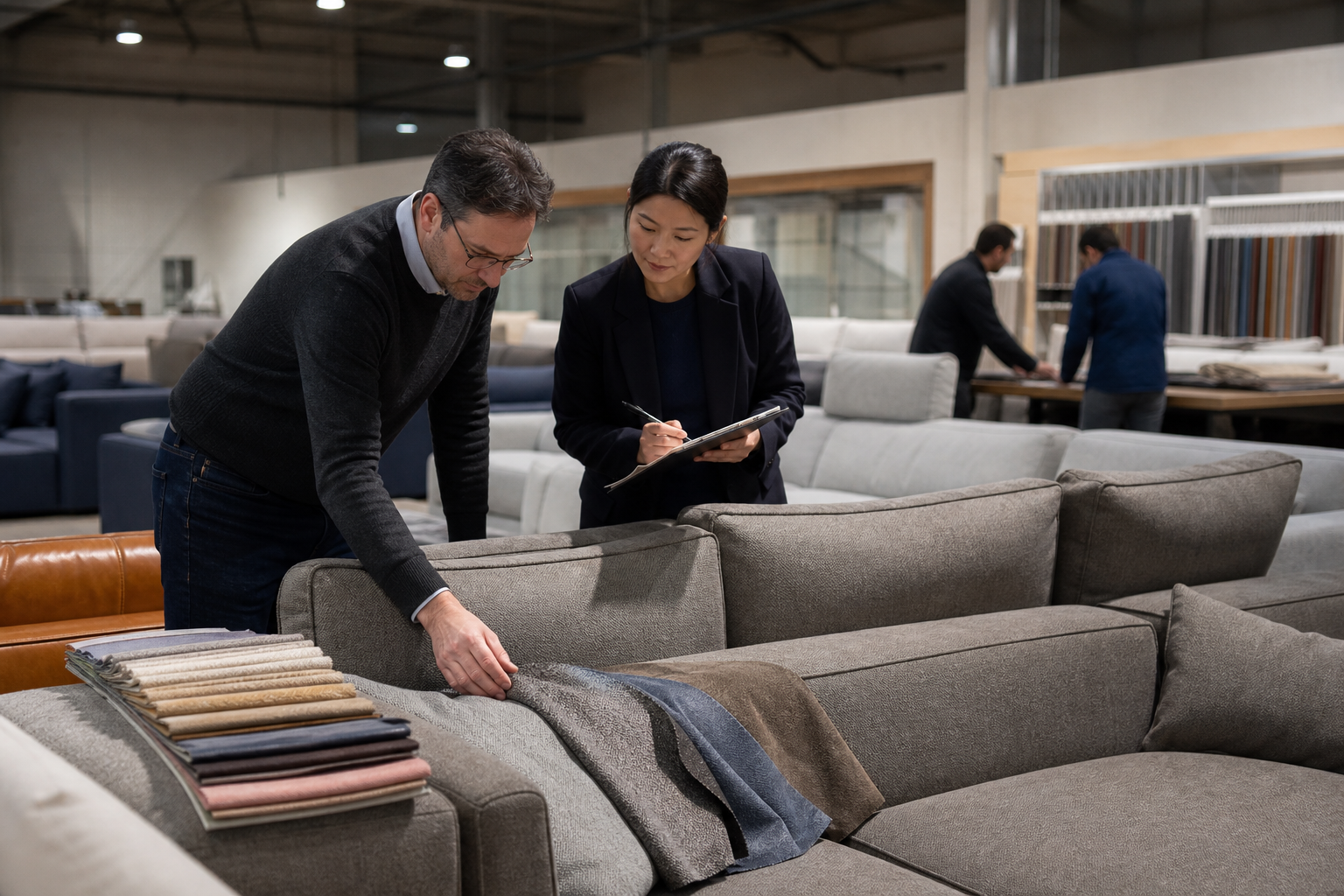
- Fabric library photos: A real, maintained fabric and component library is a sign the factory is prepared for multi-configuration products.
- Export paperwork: Copies of recent packing lists, commercial invoices, or bills of lading show experience and reduce surprises.
- Willingness to pilot: A supplier who will run a pilot program with capped exposure and shared metrics demonstrates the right incentive alignment.
How StarbornHub frames the partnership
At StarbornHub we treat the customer response you collect in-store as a practical buying signal — not decoration after a decision. The platform is platform-led cooperation backed by real factory capability: factories lead parts of the mechanism they can control (production, material sourcing, sample workflows), designers suggest product possibilities, and retailers bring local knowledge and customer feedback. The platform organizes percentage reports and urban protections, and coordinates production to those signals.
This doesn’t mean factories replace retail decision-making. Retailers still choose assortment and pricing. The factory-initiated element is a mechanism reorganization: shifting from a model where intermediaries guess what will sell, to one where buyers’ feedback, retail expertise and supply capability jointly drive product decisions.
Why does this matter to you as a retailer? Because it changes who bears what risk and how quickly you can test local taste. With a cooperative mechanism:
- You can test more styles with lower upfront inventory.
- Factories that participate can iterate designs quickly based on real local feedback.
- Pricing stays realistic because production and material choices are aligned with retail margin needs.

A short practical engagement plan
If you decide to evaluate a factory for a pilot:
1) Start with a two-month pilot: one or two SKUs, 20–50 units each, with a shared sampling plan and reporting cadence.
2) Agree on KPIs: lead time, defect rate, replenishment window, sample cost, and responsiveness to design tweaks.
3) Require a simple upstream supplier list and sample photos of core fabrics and components.
4) Insist on a named factory contact who will join weekly calls and respond to store reports.
5) Use platform-organized urban protection and percentage reporting so replenishment decisions are signal-driven.
This approach reduces your exposure and creates a clear, measurable path to scale or exit.
Conclusion
Choosing the right sofa supplier for a flexible, small-batch retail model is about more than unit price. You need a partner with the motivation to run many small SKUs, an upstream materials ecosystem that supports variety, system-level thinking on sampling and reporting, and export/operational experience. In practice, many Chinese small and mid-sized factories meet these requirements more often than equivalent European factories — not because they’re inherently better, but because their local supplier density, export habits and production experience make the mechanism viable.
Before you trust a new supplier, ask concrete questions about MOQs at the material level, sample workflows, fabric libraries, lead times, export experience, and willingness to participate in a feedback-driven system. Pilot with clear KPIs and require named responsibilities. When suppliers are willing to be part of a platform-backed cooperation like StarbornHub — where local customer response becomes a practical buying signal — you get the combination retailers need: low inventory risk, faster learning, and products that actually sell in your market.
If you want, we can walk through a sample supplier questionnaire tailored to your store footprints and preferred margin targets.
More articles in this content module
Module: Supplier Trust And Quality Responsibility
This is the full reading map for the current content block, so you can follow the logic inside this topic before jumping to another issue.
- What should a furniture retailer ask before trusting a new sofa supplier?
- What should a furniture retailer ask before trusting a new sofa supplier?
- What should a furniture retailer ask before trusting a new sofa supplier?
- What should a furniture retailer ask before trusting a new sofa supplier?
Other content modules you may want to explore
If your concern is not only this one issue, these modules open nearby paths in the StarbornHub theory system.
Another problem retailers often connect to this: A nearby visible problem the retailer may also be feeling.
Supply Chain And Delivery Risk
Can the retailer safely promise timing, delivery, and condition to the customer?
First reading in this module: When can a furniture retailer safely promise availability to a customer?
What this could improve if handled better: A positive business outcome or advantage the retailer may want.
Validation And Small-Batch Testing
What should be validated before a larger stock commitment?
First reading in this module: Should furniture retailers buy stock before testing customer demand?
Why this path may be worth testing: A trust-building or low-commitment validation question.
Validation And Small-Batch Testing
What should be validated before a larger stock commitment?
First reading in this module: Should furniture retailers buy stock before testing customer demand?