
Small-Batch Supply Reduces Retailer Stock Risk?

Roger here.
If you run an independent furniture shop, the trade-off is familiar: buy more to get unit cost leverage, or hold back and hope your marketing and content find the right customers before you commit. The straight answer from our experience at StarbornHub is that neither extreme is optimal. A structured approach—curated multi-SKU assortments bought in small batches, supported by platform coordination—lets you validate demand in-market while keeping inventory risk under control.
Demand is fragmented — stock for probability, not perfection
Furniture tastes vary across cities, neighborhoods and even store footprints. A handful of universal designs won’t satisfy every local preference, and betting a single SKU to carry your store can leave you exposed to slow turns.
The business logic is simple: diversify across a focused set of candidate styles so that demand risk is spread across multiple small winners rather than concentrated on one uncertain big bet. You’re not chasing infinite SKUs; you’re increasing the probability of a local match—styles, fabrics and finishes that actually resonate where your customers live.
That works best when your procurement signals are accurate. Put another way: small-batch buying is more effective when you choose variants based on thoughtful, localised signals rather than random experimentation.
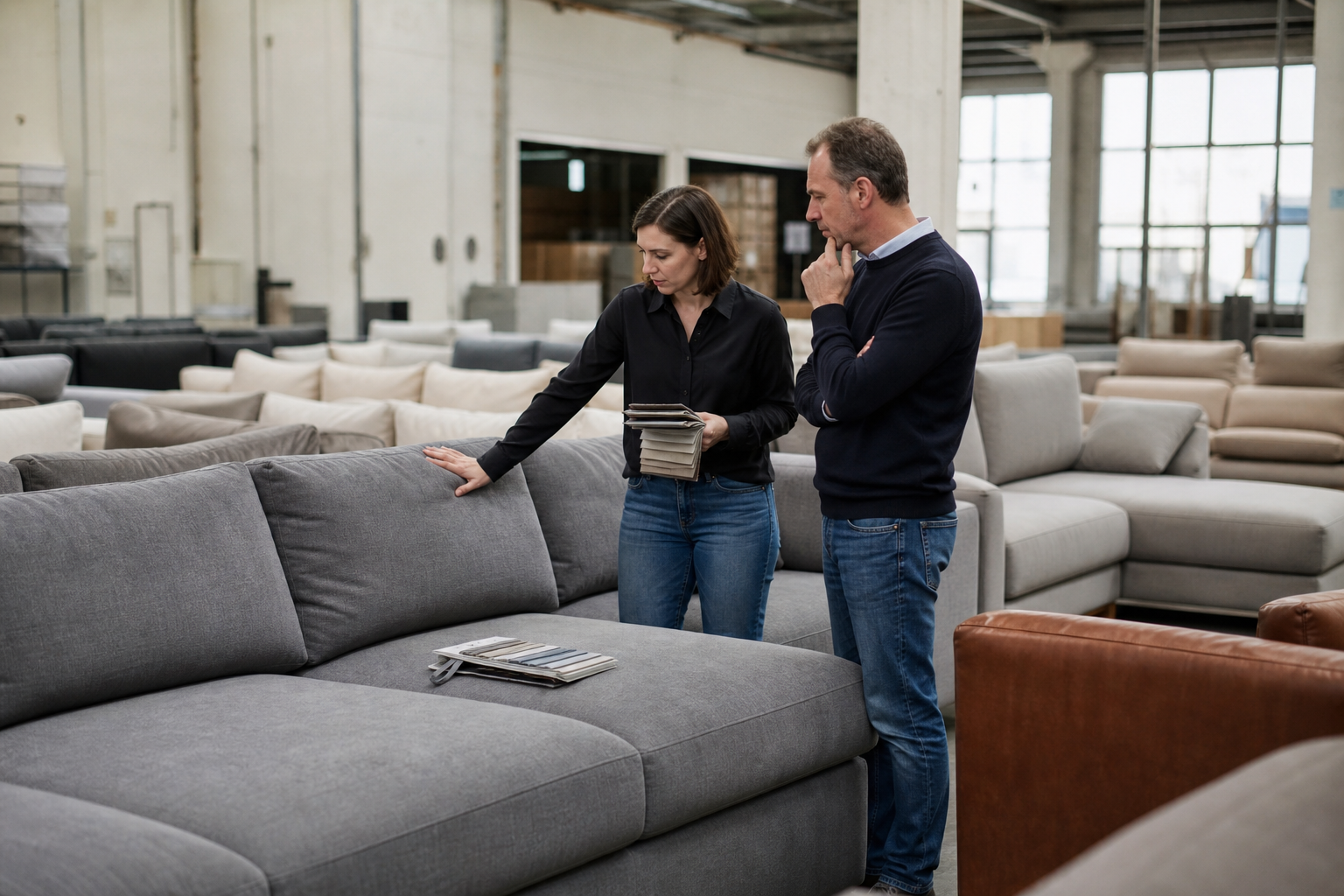
Small batches are a controlled validation tool, not disorderly stocking
When we say "small-batch," we do not mean multiplying SKUs and cluttering your floor with one-off samples. The point is to move the cost of trial from sunk space and cash to a manageable, repeatable test. Small initial buys let you:
- Put product in front of real customers in real contexts (showrooms, display corners, targeted promotions).
- Observe acceptance signals—actual touches, conversions, and customer comments—rather than relying on guesses or staged metrics.
- Collect local preferences quickly and cheaply so your next buy is more likely to sell.
Operationally, that means structuring your initial commitment to be large enough to test real demand but small enough to avoid pressure-selling or deep markdowns if the item underperforms. The goal is to learn with minimal cash drag while keeping turn and margin intact.
How platform design makes small-batch viable at retail scale
Small runs often get labeled inefficient because per-item costs for production and logistics rise. Our approach at StarbornHub is to build structures that let small-batch buying retain operational sense without pretending to eliminate economics.
Key platform mechanisms we use to make small-batch practical:
- Shared material pools and layered fabric rules: By grouping common fabrics and reserving higher-threshold processes for special materials, we let some SKUs be produced under lower minimums. That decouples production efficiency from the decision to run small trials.
- Factory-capability-backed early development: Factories take on initial sample and development work, lowering the retailer's upfront burden. That means you can showcase working samples and prototypes in-store before committing to larger runs.
- Order consolidation and flexible fulfilment: On the logistics side, combining small orders across retailers and leveraging flexible routing reduces the marginal cost of fulfilling small batches for individual stores.
These are not magic fixes. They are organisational choices that shift fixed costs away from the retailer and onto a regional, factory-side orchestration layer. For independent retailers, the practical outcome is that small-batch testing becomes an affordable, repeatable strategy rather than an expensive one-off.

From in-store votes to long-term value — why this isn’t just a clearance trick
The greatest mistake is to view small-batch purely as a short-term de-risking tool for excess stock. The strategy becomes more valuable when you link immediate validation to long-term customer and account growth.
Practical steps retailers should take to capture that long-term value:
- Convert in-store interest into platform-bound customer accounts. That way, a customer’s interaction becomes a retrievable signal rather than a one-off.
- Encourage simple, in-store feedback mechanisms (preference votes, short surveys, wishlist adds) so you build a dataset about what converts locally.
- Use those data participation history to inform subsequent buys: prioritize styles that show repeated engagement across different customer touches.
When small-batch trials are combined with account binding, local protection mechanisms, and platform-side recommendation incentives, retailers do more than test products: they grow a base of returning customers and decision-support signals. Over time, those signals compound—samples and small inventory commitments work as investments in customer assets.
Where small-batch doesn’t fit—and how to spot the limits
Small-batch buying is powerful, but it isn’t universally optimal. Consider the following boundary conditions before you adopt it wholesale:
- Production or logistics constraints: If your supply chain cannot handle frequent, small lifts, margin drag from logistics may outweigh the validation benefit.
- Severe capacity limits at factories: Where factories cannot support frequent switching or small tooling needs, small-batch becomes costly.
- A nascent customer base: Small-batch has outsized value when you already have a baseline of local users. If you lack foot traffic or any channel to convert real storefront interactions into platform accounts, the validation loop weakens.
If you face these constraints, your options are either to invest in those capabilities (build local account acquisition, negotiate fabric pools, or coordinate shared logistics) or to be more selective about when small-batch is used—for sample runs, new-category tests, or specific seasonal experiments rather than across-the-board adoption.
Practical checklist for a retailer ready to test small-batch
1. Curate a tight candidate set of styles aligned to local tastes—don’t chase volume of SKUs; chase local match probability.
2. Use small initial buys to put products in real customer contexts, track conversion metrics, and gather qualitative feedback.
3. Convert interest into platform accounts or recorded interactions so the learning accumulates over time.
4. Coordinate with platform-supported shared materials and factory sampling options to keep development cost manageable.
5. Monitor the operational costs: if logistics or production overheads grow faster than learning benefits, pause and reassess.
6. Scale winners gradually based on repeatable, local signals rather than a single early sale.
Conclusion
Small-batch supply, when paired with a curated multi-SKU approach and platform-backed mechanisms, is a practical way for independent furniture retailers to lower inventory risk while building long-term customer value. The point is not to avoid inventory commitments entirely, but to make those commitments smarter: validate in-market with manageable risk, capture the signals that predict repeatable demand, and use platform-level tools—shared materials, factory sampling, and consolidated fulfilment—to keep the economics workable.
If you’re deciding whether to buy in bulk or wait, think of the decision as a staged investment: run calibrated, small tests that convert physical interest into account-level signals. Use those signals to de-risk larger buys. That approach keeps cash flowing, floor space usable, and attention focused on the styles that will actually sell in your neighborhood.
At StarbornHub we design the ecosystem so small-batch experimentation isn’t an expensive luxury but an operationally sensible path to better local assortments and stronger customer relationships. If you already have local traffic and a plan for capturing in-store signals, small-batch trials are one of the most direct ways to turn uncertainty into predictable buying decisions.
More articles in this content module
Module: Validation And Small-Batch Testing
This is the full reading map for the current content block, so you can follow the logic inside this topic before jumping to another issue.
- Why does market pressure lead to the StarbornHub model?
- Why Independent Furniture Retailers Are the Best Validation Leverage
- Should furniture retailers test demand before buying deeper stock?
- What problem is StarbornHub really trying to solve for retailers?
- Why does StarbornHub challenge the traditional furniture supply chain?
- Why should furniture retailers validate demand before a bigger order?
- Local Customer Feedback and Safer Sofa Purchases: Turning Reports into Buying Decisions
- How much confidence should a retailer have before buying stock?
- Small-Batch Supply Reduces Retailer Stock Risk?
- Continuous Product Renewal Matters?
- The Operating Conditions Work Together?
- A Retailer Cannot Build This Mechanism Alone?
- Software Alone Cannot Solve Sofa Buying Risk
- What kind of system helps furniture retailers make safer buying decisions?
- Qualified Customer Registration Supports Buying Decisions?
- Monthly New Product Development Should Work?
- The StarbornHub Mechanisms Form A Loop?
- Inventory and Validation: Where to Draw the Line Before You Buy
- StarbornHub Uses AI Without Letting AI Decide Everything?
- AI Cannot Decide For Furniture Retailers?
- The StarbornHub Growth Flywheel Means?
- Platform Growth Must Serve Retailer Growth?
- Must Be True For The Flywheel To Work?
- StarbornHub Did Not Start From Software
- Factory Growth Depends On Retailer Customer Growth?
- StarbornHub Is Actually Trying To Validate?
- Retailers, Customers, And Factories Must Participate Together?
- StarbornHub Is Trying To Build?
- Kind Of Retailer StarbornHub Is Inviting?
Other content modules you may want to explore
If your concern is not only this one issue, these modules open nearby paths in the StarbornHub theory system.
Another problem retailers often connect to this: A nearby visible problem you may also be dealing with
Customer Asset And Relationship Capture
Are website visits, blog clicks, customer questions, and reviews being captured as usable signals?
First reading in this module: How account-linked benefits bring furniture customers back to the showroom
What this could improve if handled better: A possible business gain behind this issue
Is the sales drop caused by fewer visitors, lower conversion, weaker product fit, local market pressure, or broader economic pressure?
First reading in this module: What changed in the furniture retail market?
What it may take, cost, or risk: The practical concern before trying a new path
Traffic And Conversion Diagnosis
Is the store missing traffic, or is the existing traffic not converting?
First reading in this module: What is the operating formula behind an independent furniture store?