
Why should furniture retailers validate demand before a bigger order?
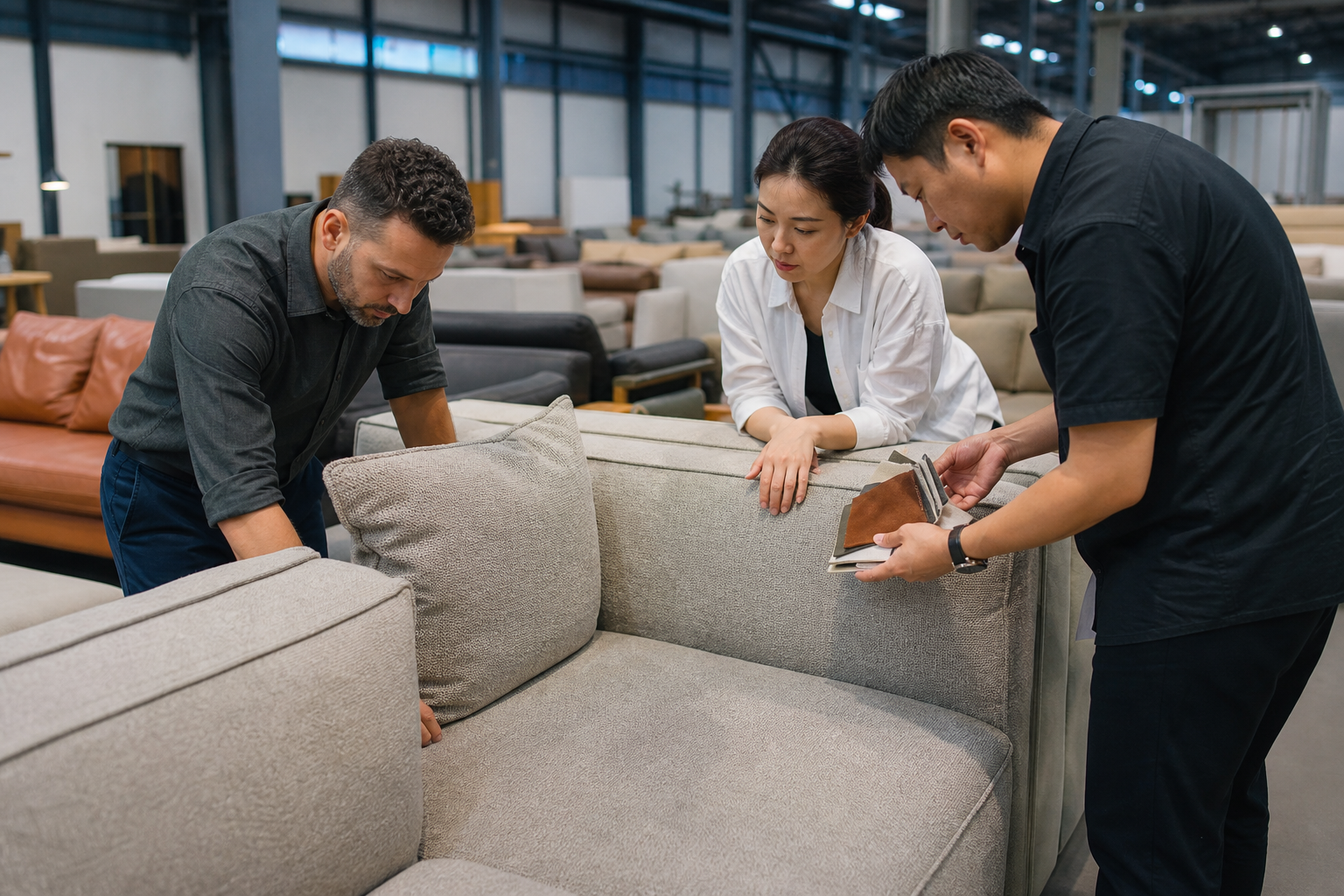
If you run an independent furniture store you know the pain: a sofa sits on the floor for months, your team keeps nudging it in the planogram, and those dead square feet could have been used for something that actually turns profit.
The root cause isn’t bad taste — it’s timing. In traditional retail the market’s voice usually arrives after you’ve paid for samples, stocked units and spent precious showroom real estate.
This article explains how to move that voice earlier in the process. We’ll cover what pre-purchase validation looks like in practice, why the old way creates slow-moving inventory, and how to use low-cost signals — including platform-led cooperation backed by real factory capability like StarbornHub — to make smarter purchasing decisions.
How the traditional process “validates” products
The classic sequence looks like this: design, sample, produce, buy inventory, display — then customers react. That reaction is the real validation: people try, compare, ask, and sometimes buy. But by the time you get those signals, the cost has already been incurred.
For small independent retailers that timing matters. A single underperforming sofa style doesn’t just tie up the unit cost; it consumes display space, sales staff attention and the opportunity to test a different SKU that might perform better. In other words, slow-moving stock is more than idle inventory — it’s a drain on the whole store’s economics.
Why that creates real problems now
A few market realities make late validation more expensive today:
- Product variety and churn are higher — there are more models and colorways to choose from, so guessing costs more.
- Customer preferences are more fragmented — what's a hit online or in another city won’t automatically translate to your neighborhood.
- Floor space and attention are scarce — every slow SKU competes with better use of the same resources.
- Margins are under pressure — holding stock longer erodes working capital and profit.
Under these conditions, relying on experience and gut feel becomes a risky financial bet. When you add showroom overhead and the rising cost of customer acquisition, the math favors lowering the cost of learning rather than hoping luck is on your side.
What pre-purchase validation means in real retail terms
Pre-purchase validation is simply getting buying signals from real, relevant customers before you commit to larger production runs. It’s not asking someone if they “like” a sofa; it’s giving enough credible choices and context so a sufficient number of target buyers make a preference, reservation or deposit — concrete signals you can act on.
Practical tactics that work for independent retailers:
- Pre-orders and reservation deposits: Offer a launch window where customers can reserve a specific finish or size with a refundable or small non-refundable deposit.
- In-showroom short tests: Place a single sample or a prototype and promote that specific model on your local channels for a limited-time test.
- Limited-run drops and pop-ups: Run a small local drop with a low MOQ produced through a cooperative or quick-turn factory channel.
- Social-first A/B tests: Run two colorways in low-cost ads or short-form content and capture sign-ups tied to each variant to see which resonates.
- Waitlists plus incentives: Collect names and use a simple email or SMS funnel to measure conversion intent when you announce availability.
- Consignment and vendor cooperation: Work with suppliers or factory partners to carry small early inventory on consignment while you test demand.
These tools let you observe real behaviors: who signs up, who puts money down, who converts from interest to purchase. Those signals are much more actionable than a “like” on a photo.
How to read the signals — what to measure
Validation isn’t binary. Treat it like an experiment with clear success criteria before you scale production. Useful metrics include:
- Reservation rate: number of deposits / number of people exposed to the test.
- Conversion rate: reservations that become paid orders after availability.
- Lead quality: incidence of local address, return customers, and engagement depth (e.g., appointments booked).
- Time-to-interest: how quickly the SKU generates sign-ups after promotion.
- Opportunity cost per square foot: margin lost by holding the sample vs. expected margin if replaced by a proven SKU.
Set thresholds for action. For example, if a new sofa generates X reservations within Y days and conversion from reservation to sale historically averages Z%, you can model expected sell-through and decide whether to place a larger order.
How StarbornHub helps make validation actionable
StarbornHub acts as a platform cooperation mechanism backed by real factory capability that bridges local demand signals and production decisions. Instead of the retailer bearing full MOQ risk alone, StarbornHub coordinates smaller runs, shared tooling, and transparent lead times so a validated local interest can be converted into a scaled but still cost-effective order.
Concretely, that means:
- Lower effective MOQ through pooled orders across retailers.
- Faster turnaround for validated SKUs because production planning aligns with confirmed demand.
- A clear pathway from reservations to factory purchase, reducing guessing.
- Shared data: when several independent retailers validate the same SKU locally, the aggregated signal justifies larger runs with better unit costs.
The mechanism doesn’t remove risk entirely, but it shifts the risk profile: more of the cost of learning happens before large capital is committed, and the retailer’s cash and floor space are conserved until demand is clear.

A simple workflow you can adopt next month
1. Pick a test candidate: one sofa style or colorway you think has potential locally.
2. Define the hypothesis: “If 20 local residents reserve with a $200 deposit within 30 days, we place a 50–100 unit order.”
3. Run a low-cost test: showcase a sample, promote a short pre-order window, and use sign-up forms or POS deposits.
4. Measure and decide: compare results to your threshold. If you hit the target, route the demand through a cooperative production channel (e.g., StarbornHub). If not, iterate on design or promotion at low cost.
5. Scale responsibly: when you place the larger order, choose a staging approach — staggered deliveries, smaller initial batch, or blended assortment — so you keep flexibility.
This routine lets your store fail cheaply and succeed with scale. Over time it turns guessing into repeatable decision rules.
Example: a small urban store testing a new sofa
You run a 1,200 sq ft showroom with steady foot traffic. A new sofa looks promising online but you’re uncertain locally. You display a single sample, produce a 30-day campaign around it, and accept reservations with a $150 refundable deposit.
Result: 18 reservations in 21 days, with 12 coming from local repeat visitors and 6 from new leads. You model conversion and decide to run a 60-unit order through a pooled factory run. Because other retailers validated the same model via the same mechanism, the effective MOQ drops and the unit cost improves. The sofa converts in 90 days at solid margin and uses the previously marginal floor space to deliver steady cash flow.
That outcome is possible because learning happened before a full production commitment. When it doesn’t hit the threshold, you’ve only used marketing time and a sample, not the full cost of inventory.
When to still accept some inventory risk
There are cases where a faster full-buy makes sense — a confirmed national best-seller, exclusive supplier constraints, or a price break that outweighs holding costs. But even then, try to break the exposure into tranches and use validated local signals to allocate the first tranche. In other words, don’t throw out validation entirely: use it to size your bet.
Bottom line
Slow-moving inventory is not only a clearance problem. It’s a symptom of making buying decisions without early, local customer signals. The remedy isn’t just faster turning or better markdowns — it’s changing when you learn. Pre-purchase validation shifts learning into a lower-cost stage and, when paired with platform-led cooperation backed by real factory capability like StarbornHub, lets independent retailers scale winners without shouldering full MOQ risk.
Start small: pick one new SKU, run a reservation test, measure against a clear threshold, and use pooled production to scale. Over time you’ll reduce slow-moving inventory not by clearing it faster, but by buying more of what your customers will actually buy.
Conclusion
The best way to reduce slow-moving inventory is not only to clear it faster. It is to build a better product selection and validation mechanism before large stock commitments are made. For an independent furniture retailer, the point is not to accept a new supplier claim blindly. The point is to make the next product decision clearer before cash, showroom space, and customer trust are already committed.
More articles in this content module
Module: Validation And Small-Batch Testing
This is the full reading map for the current content block, so you can follow the logic inside this topic before jumping to another issue.
- Should furniture retailers buy stock before testing customer demand?
- Should furniture retailers buy stock before testing customer demand?
- Should furniture retailers buy stock before testing customer demand?
- Should furniture retailers buy stock before testing customer demand?
- Should furniture retailers buy stock before testing customer demand?
- Should furniture retailers buy stock before testing customer demand?
Other content modules you may want to explore
If your concern is not only this one issue, these modules open nearby paths in the StarbornHub theory system.
What this could improve if handled better: A positive business outcome or advantage the retailer may want.
Customer Asset And Relationship Capture
Are website visits, blog clicks, customer questions, and reviews being captured as usable signals?
First reading in this module: How do I turn online browsers into showroom visitors?
Why this path may be worth testing: A trust-building or low-commitment validation question.
Supplier Trust And Quality Responsibility
What incentive does the supplier have to protect quality after the first order?
First reading in this module: What should a furniture retailer ask before trusting a new sofa supplier?