
How customer feedback can become your buying decision tool

You’re right to ask: why does a style only look wrong once it’s already on the floor?
For most independents the answer is simple and fixable — buying decisions still lean on past sales and supplier catalogues, not on rapid, local signals from today’s customers. That gap turns every new sofa into a bet on memory instead of a test of the market.
Below I’ll explain why feedback matters more today, why it beats relying on experience alone, how it shortens iteration cycles, and why it will be the key differentiator for independent retailers. I’ll also show how StarbornHub’s platform-led cooperation backed by real factory capability makes those signals actionable before you’ve spent a lot of cash or showroom space.
Why feedback matters more now
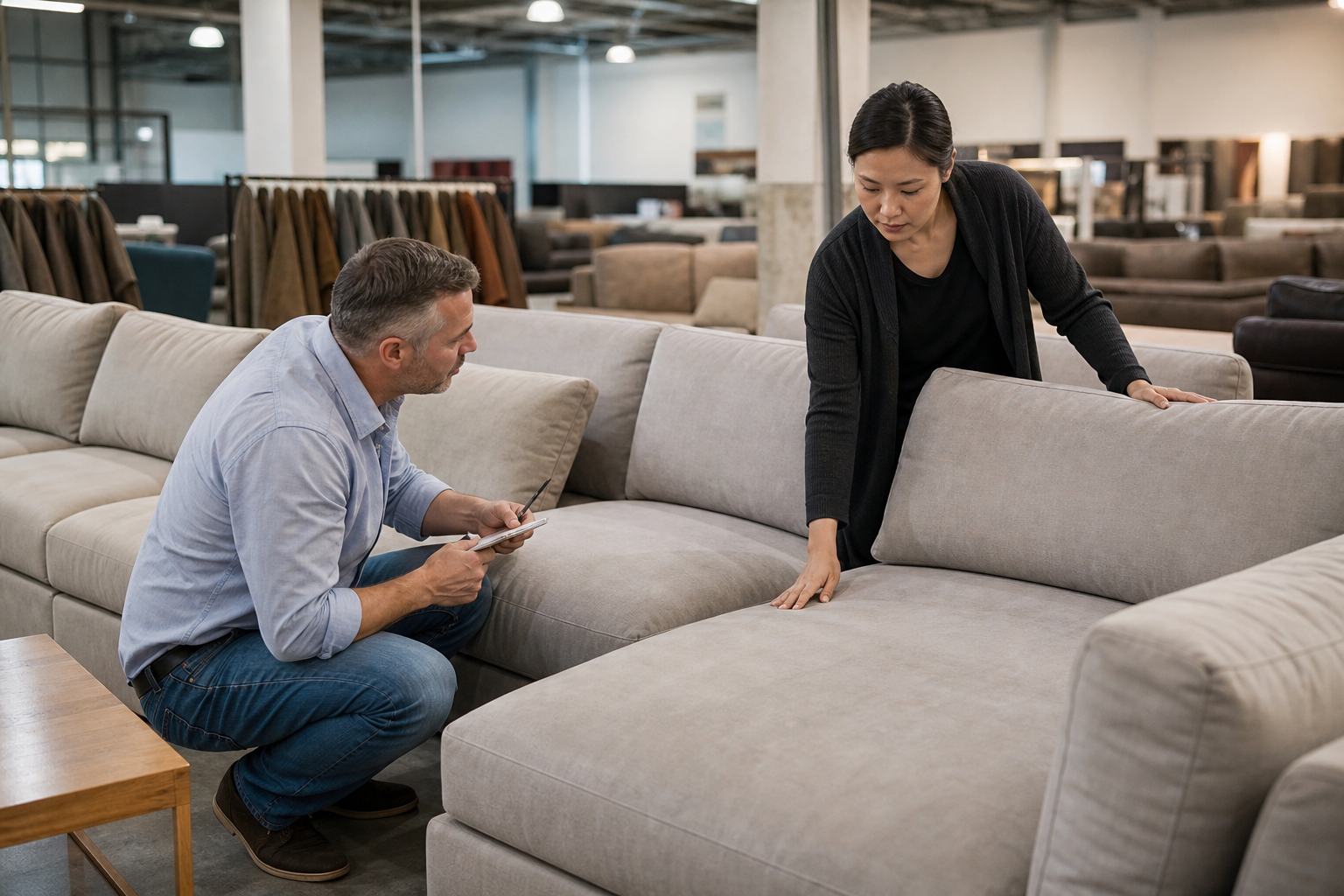
Two trends make feedback essential:
- Product life is shorter. Styles shift faster, and a look that sold last year can feel dated the moment it arrives.
- Supply is easier to access. Many independents can source similar pieces, so product alone is a weak differentiator unless you know what your customers actually want today.
Experience tells you what happened; feedback tells you what’s happening now. If you keep buying off historical intuition, you reinforce what already sold and miss the customers walking in who aren’t being served. That’s how showrooms accumulate sofas that don’t convert and tie up working capital.
Why feedback is faster than experience
Experience is backward-looking by definition. It becomes a blunt instrument when the market moves quickly. Feedback — measured customer behaviours and reactions — arrives in near real time and gives you a chance to correct course before large investments.
Practical examples of early feedback:
- Walk-in interactions: which sofas do people sit on but not buy? Which finishes do they touch and then move on from?
- Digital signals: which product pages get shares, saves, or repeated visits from your local audience?
- Local preorders and interest forms: how many customers sign up for a fabric swatch, a test sit, or an arrival alert?
These signals let you treat a new style as a small, measurable test instead of a unilateral commitment. That small change in process is what keeps your showroom fresh and your cash available for winners.
Why feedback determines iteration speed

Iteration is the process of trying, learning, and adjusting. The faster your learning loop, the fewer missed bets you make. Traditional furniture cycles — design → sampling → production → showroom → sale — are long. By the time you detect a problem, the design is already produced and paid for.
Speed up that loop with three specific changes
1. Measure before you commit hard cash. Use reservation lists, limited pre-sells, QR-code interest forms, or targeted small-batch orders to gauge demand.
2. Run small, intentional tests. Bring in a single sample for a weekend, or order 5–10 units in a neutral fabric to see how it performs locally before a larger buy.
3. Make feedback actionable. Set simple thresholds that trigger either reorder, tweak, or drop decisions (for example: 20 showroom sit-tests with <3 follow-up inquiries = redesign; 30 interest signups in 60 days = scale up).
Those rules let you iterate on assortments based on measured response, not on hunch. The result is faster course correction and less capital tied to non-performing pieces.
Why feedback becomes your competitive advantage

When products become easier to copy or buy from the same suppliers, the retailer who understands their local buyer first wins. Feedback capability becomes differentiation for three reasons:
- Relevancy: You stock items that feel right to your community, increasing conversion and reducing markdowns.
- Cash efficiency: You spend working capital on proven demand instead of speculative inventory.
- Speed: You bring winning designs to repeatable production faster than competitors who wait for long sales cycles to teach them.
In short: retailers with tight feedback loops sell more, waste less, and respond to trends faster.
How to build a feedback-first buying process (practical steps)
Start small. You don’t need a data science team. Focus on high-impact, low-complexity signals and make them a formal part of buying.
1. Instrument your showroom
- Track simple activities: sits, photo-shares, fabric requests, and follow-up inquiries. Record them as product-level signals.
- Use QR codes next to samples that lead to a one-question interest form: "Would you consider this for your home? Yes / Maybe / No". Keep it quick.
2. Set signal thresholds
- Define what counts as success in advance (e.g., 25 interest responses in 30 days → reorder; <8 sits in 30 days → discontinue test).
- Use thresholds to avoid emotional decisions. Treat results like experiments.
3. Run micro-buys and pre-sells
- Instead of ordering 40 sofas, take a smaller initial run (5–10) or use a two-week showroom exclusive.
- Offer a limited-time pre-order with a deposit. Pre-orders convert surface interest into a stronger signal.
4. Close the information loop with suppliers
- Share local feedback (what customers touched, asked about, rejected) with your supplier. Ask for small tweaks (alternate seat depth, a different leg color, a different cushion fill) and retest.
5. Rotate samples and keep a test budget
- Dedicate a fixed monthly budget to experimentation. Rotate one or two new samples each month and measure response.
6. Make decisions quickly
- Decide weekly or biweekly on whether to scale, tweak, or drop a test item. Speed is the point.
How StarbornHub makes this practical
StarbornHub is built around the idea that independent retailers need clearer product-selection signals before deeper sofa stock commitments. We’re a platform cooperation mechanism backed by real factory capability: not a middleman, but a way for small retailers to convert local feedback into factory actions.
Here’s how the mechanism helps:
- Aggregated micro-orders: StarbornHub lets several independents test small runs together. That lowers per-store risk while preserving local feedback authenticity.
- Rapid sample runs: Factories coordinated through StarbornHub can produce single-sample or small-batch runs faster and at better cost than ad-hoc orders.
- Shared learning: When a design shows strong local signals in multiple markets, StarbornHub can scale production and offer localized fabric or trim variants based on retailer feedback.
- Clear precommitment options: Instead of paying for large inventory, retailers can use the platform’s reservation and deposit features, turning ambiguous interest into actionable signals for the factory.
That combination turns what retailers already do — talk to customers and watch behaviour — into a disciplined buying process that factories can respond to quickly.
Examples that work
- A store noticed high Instagram saves on a low-back sofa but few purchases. They ordered a single sample in a different fabric via StarbornHub and ran a weekend test for RSVP guests. The new fabric increased inquiries 3x and converted to four pre-orders; the retailer then placed a small batch and avoided a larger failed buy.
- Multiple independents in the same metro tested a compact chaise design. Each placed a 6-unit micro-order. Combined feedback showed strong demand in one fabric; the factory adjusted the run for that market without forcing any single store to carry excess stock.
What to change in your buying checklist today
- Replace “I liked this at market” with “How will local customers respond?”
- Add a simple feedback plan to each buying decision: sample test, threshold, and action.
- Reduce first-order quantities and use pre-sell or reservation tools.
- Share feedback upstream and ask suppliers for small-run flexibility.
Final takeaway
Not knowing which sofas deserve cash and showroom space is a solvable problem. When you treat customer feedback as the primary buying signal, you reduce risk, speed up learning, and make inventory choices that fit today’s buyers — not last season’s ledger.
StarbornHub helps independents turn local signals into factory action, enabling small experiments and letting you scale only the winners. The result is a showroom that converts better and a balance sheet that breathes easier. Start by instrumenting one product slot this month and use that learning to change your next buy.
Conclusion
StarbornHub is built around the idea that independent retailers need clearer product-selection signals before deeper sofa stock commitments. For an independent furniture retailer, the point is not to accept a new supplier claim blindly. The point is to make the next product decision clearer before cash, showroom space, and customer trust are already committed.
More articles in this content module
Module: Customer Feedback Timing
This is the full reading map for the current content block, so you can follow the logic inside this topic before jumping to another issue.
- Why do furniture retailers learn what customers want too late?
- Why do furniture retailers learn what customers want too late?
- Why do furniture retailers learn what customers want too late?
- Why do furniture retailers learn what customers want too late?
Other content modules you may want to explore
If your concern is not only this one issue, these modules open nearby paths in the StarbornHub theory system.
What this could improve if handled better: A positive business outcome or advantage the retailer may want.
Customer Asset And Relationship Capture
Are website visits, blog clicks, customer questions, and reviews being captured as usable signals?
First reading in this module: How do I turn online browsers into showroom visitors?
What it may take, cost, or risk: A decision concern about work, cost, risk, staff burden, or what the retailer might lose.
Validation And Small-Batch Testing
What should be validated before a larger stock commitment?
First reading in this module: Should furniture retailers buy stock before testing customer demand?
Why this path may be worth testing: A trust-building or low-commitment validation question.
Supplier Trust And Quality Responsibility
What incentive does the supplier have to protect quality after the first order?
First reading in this module: What should a furniture retailer ask before trusting a new sofa supplier?