
How should a furniture store build a stronger product range?
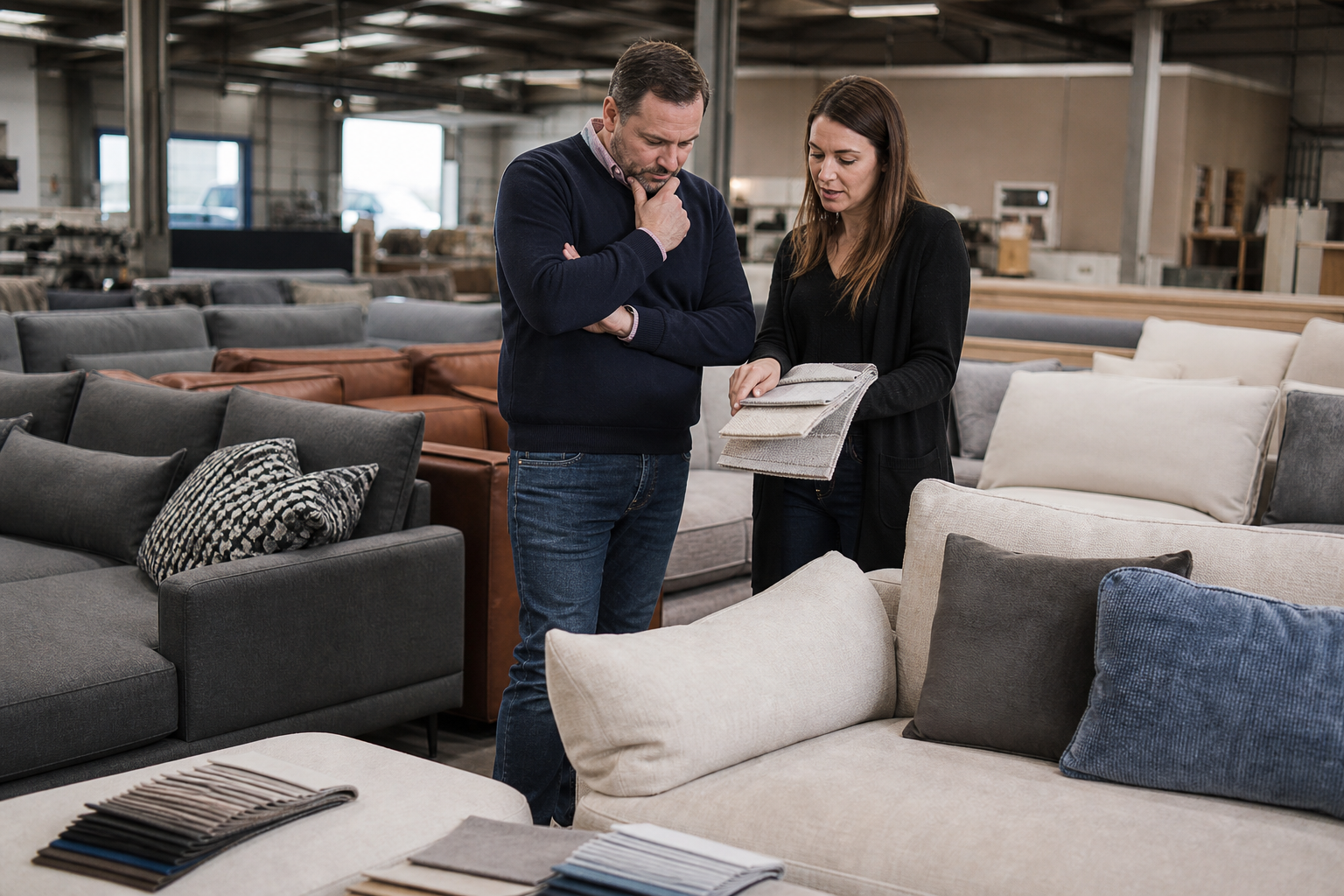
Slow-moving sofas do more than sit on your floor.
They tie up cash, occupy valuable showroom space, demand sales attention and quietly reduce the whole store’s productivity. The best way to fix that is not to run faster at clearance sales — it’s to change how you pick, test and keep products in the first place.
This is about product-combination capability: looking at your catalogue as a system that serves a target customer, price bands and showroom reality. For small and mid-size independent retailers that means every piece on display should earn its place, not by gut feeling, but by measurable contribution.

The trade-offs: not more, not less
Adding SKUs makes the store look diverse, but it raises complexity — inventory, display needs, sales training and overheads all climb. Too many experiments dilute buying power and leave capital scattered across SKUs that may never prove themselves.
On the flip side, too few options can lose customers. Demand is fragmenting across styles, sizes and living patterns; a narrow assortment misses people who walked in wanting something just different enough.
The practical middle ground for independents is an assortment where each in-store style has a high likelihood of being accepted by local buyers, is reasonably easy to sell, and is worth the floor space it consumes.
Make product choices a financial discipline, not a feeling
Turn subjective taste into store economics. Ask for every displayed style: does it pay for the space it uses? A simple set of measures gives you that answer.
Define the store variables first:
- A = store’s total monthly operating cost (rent, utilities, staff, financing, etc.)
- S = total display area (square meters or square feet)
- B = A / S = monthly cost per unit of display area
- C = total area actually occupied by on-sale SKUs
- U = C / S = display utilization rate
For each style i, track:
- J_i = area occupied by style i
- K_i = average monthly sales revenue for style i in your observation window
- X_i = gross margin rate for style i (expressed as a decimal)
Compute the style’s monthly gross-profit contribution
G_i = K_i * X_i
If you allocate area cost proportionally, the baseline cost of that style is:
P_i = J_i * B
Retention test (basic)
Keep style i if G_i >= P_i * R
R is a retention multiplier you set (>1 if you want a safety margin). A stricter allocation treats every style as carrying a slice of total store cost:
P_i = A * (J_i / C)
The logic is the same: a style must prove it creates enough gross profit to justify the store resources it consumes. If it doesn’t, it goes on the replacement candidate list.
A useful operational metric is unit-area effectiveness:
G_i / J_i = (K_i * X_i) / J_i
This tells you which styles use display real estate most efficiently. Lower values mean the style is a good candidate for review.
A practical validation cycle for sofas
How do you reduce the risk of buying a full container of a new sofa model? By small-batch validation and a clear replacement discipline.
Steps you can apply immediately
1. Define a test SKU run. Order a small sample batch — e.g., 6–12 sofas in the most-likely-to-sell fabric and finish. This keeps cost and commitment low while giving enough exposure.
2. Position for learnings, not vanity. Put the test pieces in a realistic setting, where customers can sit and compare. Track the traffic, enquiries, quotes and conversions linked to that exact SKU.
3. Measure the right numbers. For the test period (one to three months): monthly revenue K_i, gross margin X_i, area J_i, enquiries-to-quote ratio and conversion rate. Calculate G_i and G_i/J_i.
4. Apply the retention rule. If the SKU’s G_i covers its area cost under your chosen R, it deserves longer. If not, check whether the fail was due to placement, price or sales knowledge.
5. Run a short remediation window. Before cutting, give the SKU a defined remediation period: repositioning on the floor, a focused sales brief, a targeted price promotion, or a different fabric. If it still fails, replace it.
6. Scale with confidence. When a SKU clears the test and covers its cost, scale reorders in small increments. Buy larger batches only after several validated cycles, or use factory-side small-batch production to raise quantities without big lead-time penalties.
StarbornHub’s role: factory-side small-batch cooperation
Independent retailers don’t have to go it alone. StarbornHub provides a mechanism for short runs and shared factory capacity so you can run proper tests without paying the usual minimums and lead-time penalties.
How it helps in practice:
- Small production runs: order-tested volumes (not container loads) so you can validate demand without tying up cash.
- Faster feedback loops: the hub consolidates learnings across local retailers and improves pattern, fabric and finish choices.
- Operational support: coordinated shipping, limited customization, and logistics that let you keep on-floor turnover high while minimizing aging stock.
This is not hand-waving: it’s about aligning supply flexibility with the commercial discipline of area-based profitability. When factories accept smaller batches because multiple retailers coordinate through StarbornHub, you get the inventory agility retailers need.
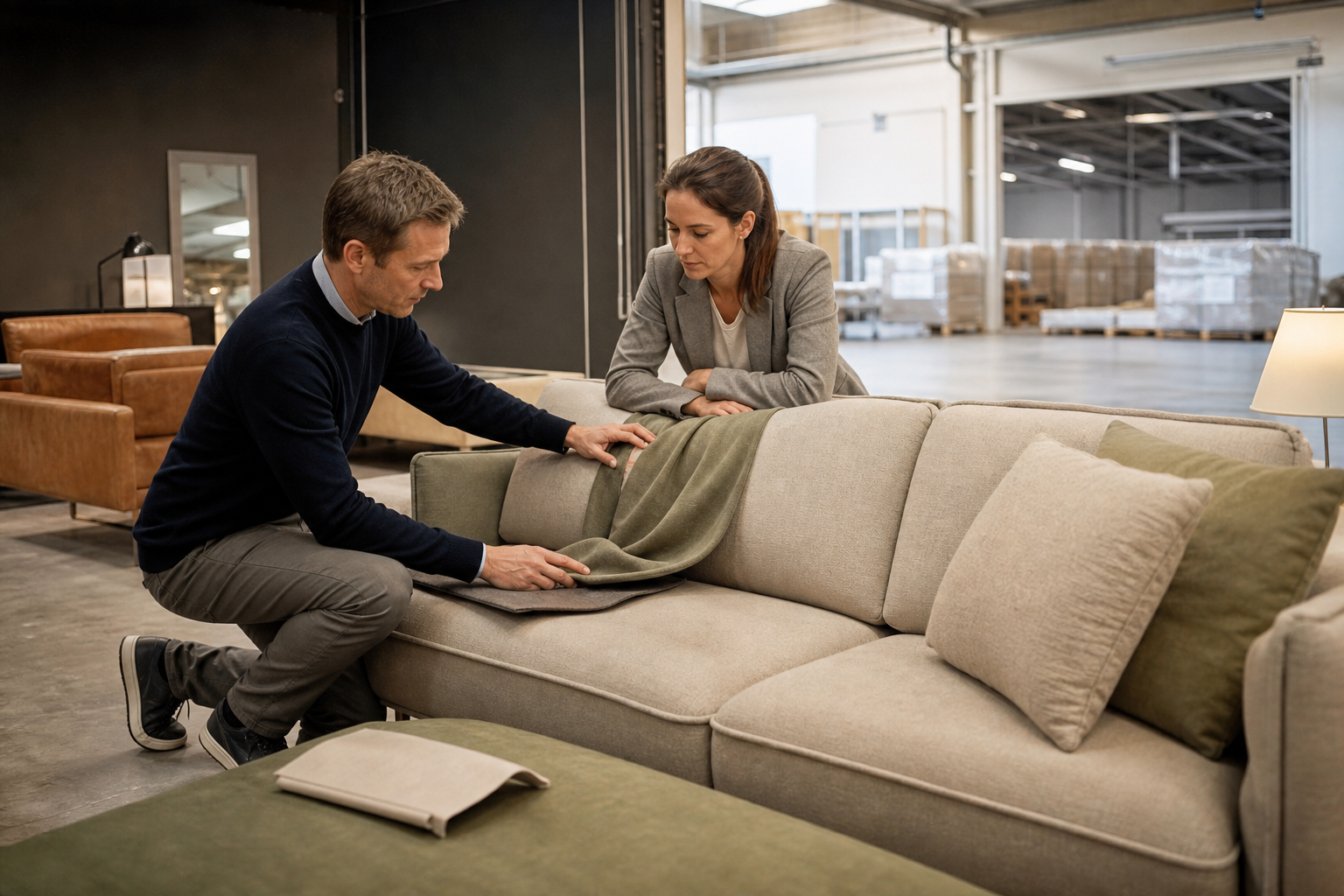
Review cadence and practical KPIs
Set a monthly or quarterly review with a short dashboard per SKU. Key items:
- Sell-through rate (units sold / units available in the period)
- Days on floor (average for the SKU)
- G_i and G_i/J_i (area-adjusted gross contribution)
- Conversion rate for enquiries tied to the SKU
- Price adjustments and margin erosion
- Customer feedback and reasons for non-purchase
Use these to make disciplined replacement decisions rather than emotional ones. A SKU should only be kept if it clears the economic test or there is a clear, short remediation path that improves the metrics.
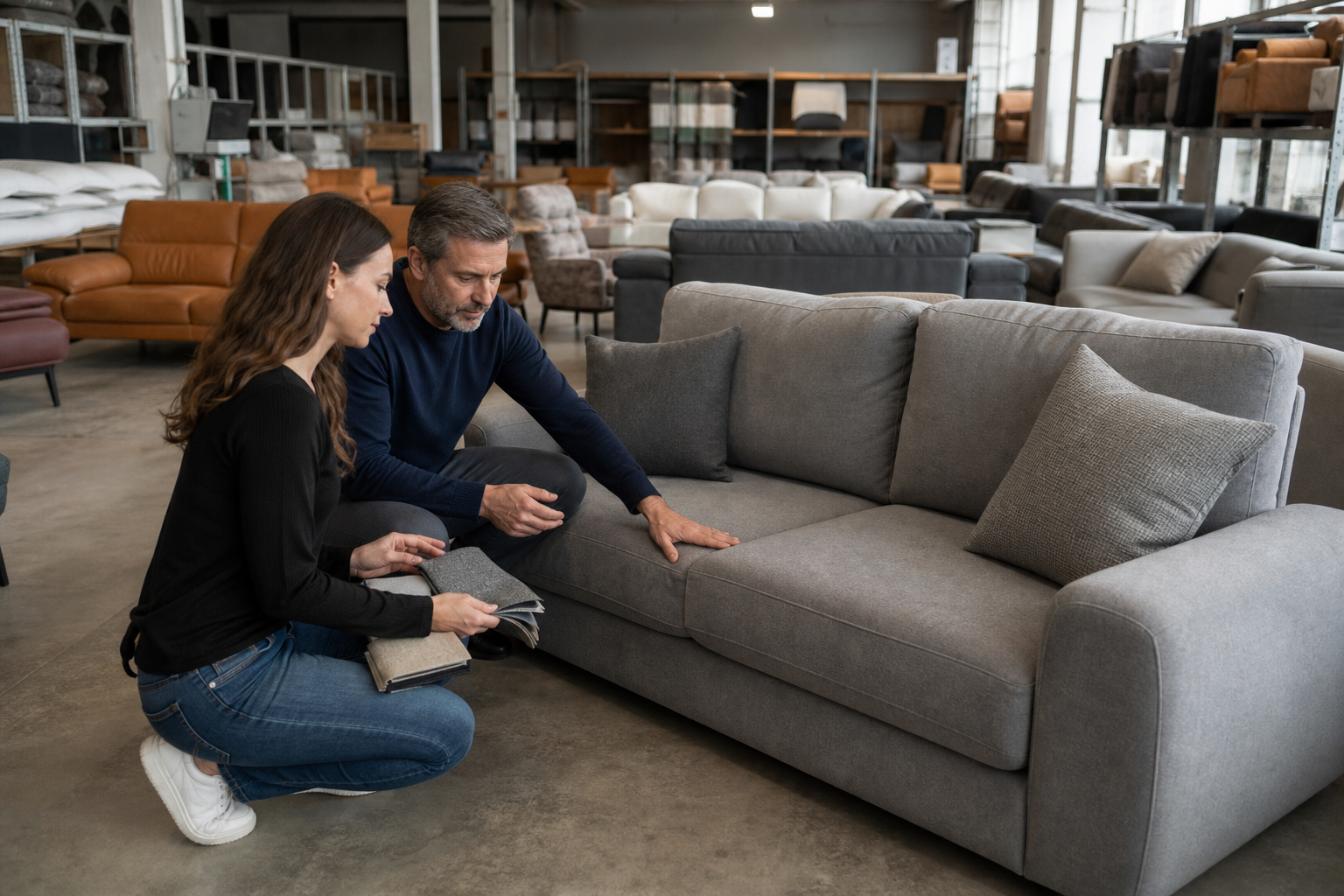
Example (illustrative)
Imagine a style occupying 8 m2 (J_i = 8). Your store cost A is $24,000/month, display area S is 300 m2, so B = 80 $/m2. The style’s baseline area cost P_i = 8 * 80 = $640. If its monthly sales K_i = $3,000 and margin X_i = 40% (0.4), then G_i = 1,200. The style passes the simple area test because 1,200 >= 640. Its area efficiency G_i/J_i = 150 $/m2 — a value you can compare to other SKUs.
If the same style’s G_i had been $400, it would clearly be using space at a loss and should be reviewed after the remediation window.
Make the tail your operating lever
Inventory risk comes not from single items, but from a weak retention mechanism. The right product-combination capability is a steady tail-elimination process: test small, measure consistently, remediate quickly, replace decisively.
For independent retailers, product mix is an efficiency problem as much as a merchandising one. If every in-store style must demonstrate it earns the space it occupies, your range becomes leaner, more locally relevant and less dependent on large clearance events.
StarbornHub exists to make that practical: giving access to small-batch factory runs, consolidated logistics and a marketplace of local learnings so your product-validation cycle is fast, cheap and repeatable.
Start by choosing one category — sofas are perfect — run a few structured small-batch tests, and apply the area-based retention discipline. Over a few cycles you’ll see fewer slow movers, smarter buys and a showroom that actually earns its right to exist.
Conclusion
The best way to reduce slow-moving inventory is not only to clear it faster. It is to build a better product selection and validation mechanism before large stock commitments are made. For an independent furniture retailer, the point is not to accept a new supplier claim blindly. The point is to make the next product decision clearer before cash, showroom space, and customer trust are already committed.
More articles in this content module
Module: Product Selection Risk
This is the full reading map for the current content block, so you can follow the logic inside this topic before jumping to another issue.
- How do furniture retailers know which sofa styles will sell?
- How do furniture retailers know which sofa styles will sell?
- How do furniture retailers know which sofa styles will sell?
- How do furniture retailers know which sofa styles will sell?
- How do furniture retailers know which sofa styles will sell?
Other content modules you may want to explore
If your concern is not only this one issue, these modules open nearby paths in the StarbornHub theory system.
What this could improve if handled better: A positive business outcome or advantage the retailer may want.
What do local customers accept in size, price, comfort, color, delivery time, and style?
First reading in this module: How do I know what my local furniture customers actually want?
What it may take, cost, or risk: A decision concern about work, cost, risk, staff burden, or what the retailer might lose.
Validation And Small-Batch Testing
What should be validated before a larger stock commitment?
First reading in this module: Should furniture retailers buy stock before testing customer demand?
Why this path may be worth testing: A trust-building or low-commitment validation question.
Supplier Trust And Quality Responsibility
What incentive does the supplier have to protect quality after the first order?
First reading in this module: What should a furniture retailer ask before trusting a new sofa supplier?