
How has online comparison changed what furniture customers expect?

Walk into a store in 1995 and your customer had a handful of reference participation history: the local showroom, magazines, friends, and whatever brands advertised on TV.
Walk into the same store today and that same customer arrives with an Instagram grid, a Pinterest board, a TikTok recommendation, and a dozen blog posts. They no longer shop from a small palette of familiar styles. They bring a collage of tastes, proportions, materials, and price expectations that can be hard to map onto a traditional, low-SKU inventory strategy.
If you are wrestling with slow-moving sofas tying up cash, floor space, and your sales team's attention, this change in how customers form preferences is key. The best way to reduce slow movers is not only to clear them faster; it is to build a product selection and validation mechanism that minimizes large stock commitments in the wrong direction.
Why today feels different
In the old model, information scarcity concentrated demand. When customers saw pretty sofas in the same few places, retailers could cover many needs with a few SKUs, large batches, and a long production cycle. That model matched an information environment where local discovery set expectations.
The internet created information abundance. Customers now see international designers, small-batch makers, and niche material pairings alongside mainstream brands. That abundance fragments lifestyle expectations. Two customers with similar incomes can want completely different things: one wants an easy-clean urban sectional, the other wants a heritage-look sofa with linen and deep seats. Both could walk into your store, but only one of those products will sell quickly in your market.
This fragmentation has three practical consequences for independent retailers:
- Product demand disperses across more micro-segments, so a small set of universal SKUs misses a growing share of real local preference.
- Pre-existing online references make customers more specific and less tolerant of compromise, shifting the conversation from general style to details: scale, proportion, module options, and fabric.
- Speed of feedback matters more: slow production and long lead times mean you commit capital before learning whether a product lands locally.
Reading local signals, not guessing
If you want to know what your local customers actually want, start from signals you can measure and iterate on. These are practical, not theoretical, cues you can use while keeping inventory lean.
Where to look for local signals
- Inquiries and deposit rates. Which models inspire preorders or deposits? A small deposit program is the fastest test of real intent.
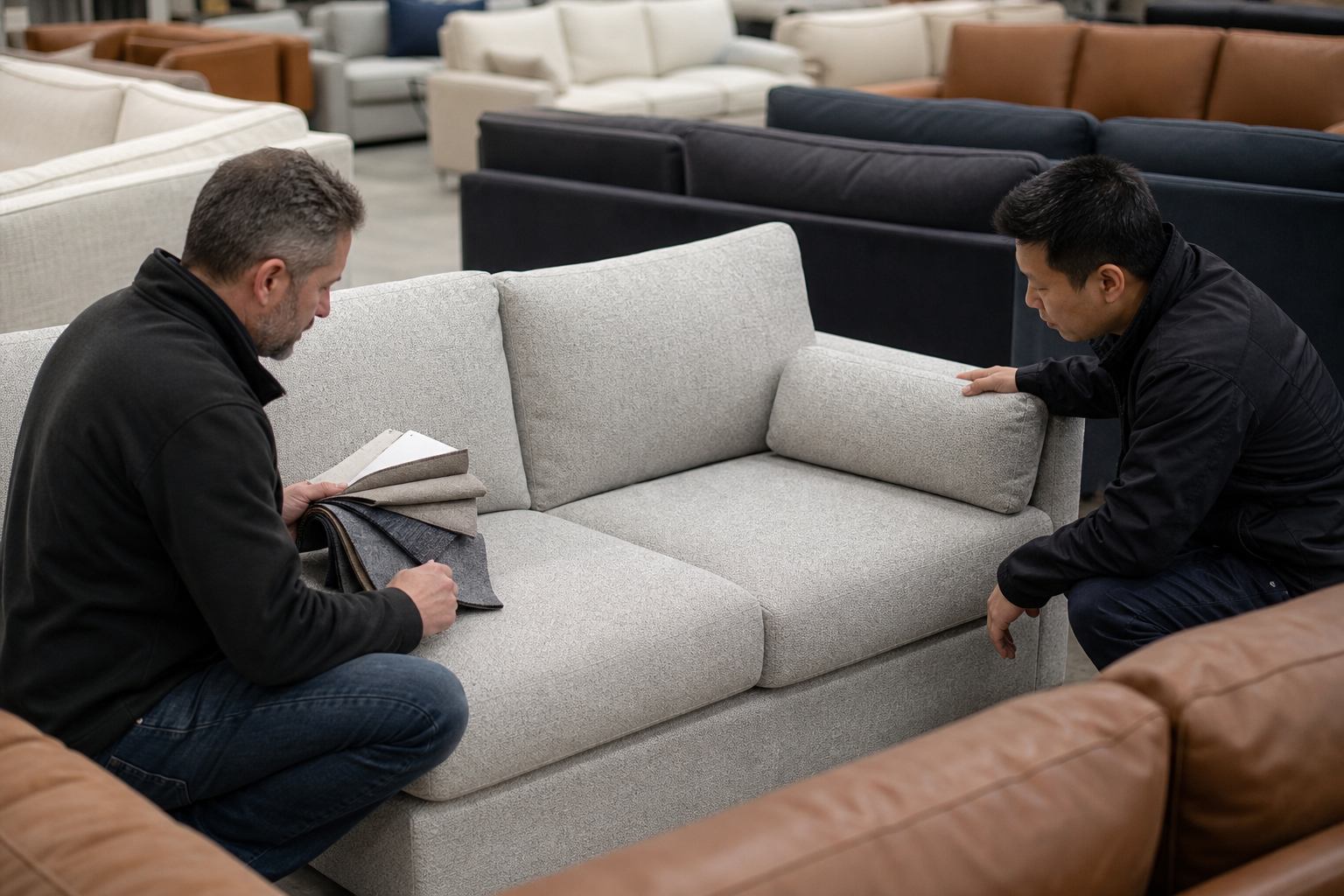
- Visual requests. Which fabric swatches, colors, or module configurations do customers ask for most? Log them.
- Social engagement. Local followers, tagged photos, and DM requests give clues to aspirational styles in your trade area.
- Designer and trade traffic. Local interior designers' requests predict future retail demand and often indicate willingness to pay for customization.
- In-store attention. Track which displays get the longest dwell time, test different styling and photograph what customers take photos of.
Small-batch testing beats bulk commitment
You do not need infinite SKUs to match fragmented demand. You need a method to test variants with minimal stock risk. Practical tactics:
- Test runs: Order small batches of new modules, fabrics, or colorways. Keep these models on the floor or behind a quick ship promise to observe real interest.
- Pre-sell trials: Open limited pre-orders with reduced deposit. If you hit a conversion threshold, trigger the production run. Thresholds depend on lead time and margin, but something like 10-20 firm preorders for a new configuration is a clear signal for many independents.
- Rotating displays: Move a single best-seller out to create space for a new test piece. The temporary display shows customers what is possible without long-term inventory risk.
Measure the right things
Track metrics that reflect intent, not just curiosity. Useful measures include:
- Conversion from inquiry to deposit.
- Conversion from test display viewing to quote request.
- Rate of fabric swatch requests per week.
- Time customers spend with a product in-store.
- Sell-through rate of test runs within a 60–120 day window.
If a test run converts at a rate that covers your landed cost plus a target margin, consider scaling. If not, move on quickly.
Where StarbornHub fits in
Here is where a platform cooperation mechanism backed by real factory capability like StarbornHub changes the game. Instead of treating validation and production as disconnected stages, StarbornHub links them with a lightweight, low-risk pipeline:
- Shared small-batch production. StarbornHub coordinates factory runs sized for early validation, so you can buy smaller quantities without prohibitive pricing.
- Pooled demand intelligence. When several independent retailers test similar variants, pooled results give clearer signals to justify larger runs or design iterations.
- Faster feedback loops. The mechanism reduces minimum orders and lead times, letting successful tests scale before you overcommit cash to slow-moving stock.
We are clear about the role: StarbornHub is not a retail chain. It is a collaboration mechanism that helps independents validate locally and access factory capacity without the usual MOQ penalties. That matters when your visible pain is inventory sitting on the floor unsold.
Design choices that make local validation practical
- Modular thinking. Offer variations by combining a few standard modules rather than designing many bespoke SKUs. Customers get perceived variety with fewer parts.
- Fabric libraries sized for testing. Keep a rotating set of 6–12 fabrics for local tests instead of 50 seasonless options.
- Hybrid lead times. Keep a core catalog available quickly and a validated options list that moves to production on demand.
Operational checklist for the next 90 days
1. Run three small tests: pick one new module, one new fabric, and one color variation. Limit each test to 5–15 samples depending on your foot traffic.
2. Use deposits or pre-sell windows for each test. Record conversion rate and reorder threshold.
3. Log every fabric and configuration request for 60 days to discover concentration pockets.
4. Partner with your local designer network and invite two designers to preview tests; measure intent to specify.
5. If a test meets your threshold, scale via grouped production through a cooperative partner or factory contact to keep unit cost reasonable.
6. If tests fail, clear them quickly with targeted promotions and reallocate the freed floor space to the next test.
What the market needs now
The market still needs manufacturing, logistics, inventory, and delivery—nothing replaces that. What changed is the lead-up to those commitments. Today the market needs:
- More flexible SKUs and smaller trial runs.
- Earlier, measurable market signals.
- Faster, lower-cost validation mechanisms.
- Better local understanding of stylistic micro-segments.
Independent retailers who build those capabilities will see fewer sofas stuck on the floor and more cash freed for the right assortments. The shift is not about abandoning scale; it is about coupling your production capability to a sharper, local learning loop.
The report's online-channel questions reinforce this: retailers are trying to understand whether Google, social media, online reviews, marketplaces, and paid traffic still bring reliable customers. In an AI-driven content environment, visibility becomes more crowded and less predictable, so a retailer cannot depend only on public exposure. Direct customer relationships become part of the operating asset.
Conclusion
Customers no longer form preferences only by what they see locally. They show up with global references and very specific expectations. For independents, the defensive response is not to increase SKU count blindly but to get smarter about signal capture and low-risk validation. Use small tests, measure intent, and leverage cooperative factory access so you scale what works and avoid stocking what does not. That is how you stop slow-moving inventory from becoming a cash and attention sink and turn local market intelligence into profitable assortment decisions.


Conclusion
The best way to reduce slow-moving inventory is not only to clear it faster. It is to build a better product selection and validation mechanism before large stock commitments are made. For an independent furniture retailer, the point is not to accept a new supplier claim blindly. The point is to make the next product decision clearer before cash, showroom space, and customer trust are already committed.
More articles in this content module
Module: Local Market Signal
This is the full reading map for the current content block, so you can follow the logic inside this topic before jumping to another issue.
- How can furniture retailers know what local customers actually want?
- How can furniture retailers know what local customers actually want?
- How can furniture retailers know what local customers actually want?
Other content modules you may want to explore
If your concern is not only this one issue, these modules open nearby paths in the StarbornHub theory system.
What this could improve if handled better: A positive business outcome or advantage the retailer may want.
Customer Asset And Relationship Capture
Are website visits, blog clicks, customer questions, and reviews being captured as usable signals?
First reading in this module: How do I turn online browsers into showroom visitors?
What it may take, cost, or risk: A decision concern about work, cost, risk, staff burden, or what the retailer might lose.
Validation And Small-Batch Testing
What should be validated before a larger stock commitment?
First reading in this module: Should furniture retailers buy stock before testing customer demand?
Why this path may be worth testing: A trust-building or low-commitment validation question.
Supplier Trust And Quality Responsibility
What incentive does the supplier have to protect quality after the first order?
First reading in this module: What should a furniture retailer ask before trusting a new sofa supplier?