
Who really decides whether a sofa style will sell?

You want to know which sofas will sell before you commit floor space and cash.
That’s understandable — and that’s exactly the tension in traditional furniture supply chains. Upstream teams (designers, factories, wholesalers) make most of the product decisions; the customer only shows up at the end to either validate or reject those choices. By then, a lot is already committed: samples, tooling, inventory, and showroom layouts.
That sequence is why so many retailers carry slow-moving inventory. The fix isn’t just better markdown tactics. It’s a different decision sequence: involve the customer earlier and build a reliable validation loop so you can make large commitments only after real local demand has been proven.
The customer is the real decision-maker
Customers decide by paying. They decide whether a style, a fabric, a size, a price, and a delivery promise fit their home and family. For sofas, the decision depends on many interacting things:
- How it fits the living room footprint and sightlines.
- How it feels to sit on (comfort and ergonomics).
- The fabric and color working with existing décor.
- The perceived value vs. price (including trust in delivery and aftercare).
- Family dynamics: who pays, who approves, who sits on it daily.
A sofa that looks great in pictures still needs to earn trust in all those dimensions. Designers and buyers can predict, but prediction is not the same as validation.
The usual process puts customers last — and that creates risk
The common workflow goes: design ideas → sampling → factory approval → larger runs → wholesaler/retailer selection → showroom. Customers only participate at the final step: buying or not.
That means the industry’s most important voice, the buyer, rarely shapes the decisions that determine whether a product will survive. When the customer’s feedback arrives only after significant costs are sunk, failures are expensive. You end up clearing inventory, discounting, or carrying dead SKUs.
For independent retailers — with limited display space, tighter cashflow, and deeper local market knowledge — this upstream-first rhythm is especially painful. You can’t afford to gamble the showroom with a product that won’t connect.

If the customer decides, act like they do — earlier
If we accept that customers decide the outcome, the practical business response is simple: treat customer response as a decision input, not only a post-mortem. That means shifting from big, one-shot inventory bets to staged validation. Practically, this looks like:
- Small batch testing: move from full production to limited runs that allow you to test variations in fabric, cushion density, or scale.
- In-store samples and trials: give shoppers the chance to sit, measure, and imagine the piece in their space — but only after you have a small, local quantity to measure real purchase interest.
- Pre-orders and reservations: use deposits or reservation systems to capture commitment without full inventory exposure.
- Local signal measurement: track conversion rates, reservation-to-sale ratios, and qualitative reasons for rejection. Quantify what matters in your store and neighborhood.
These steps don’t eliminate risk, but they make risk manageable and measurable. You learn what local customers will accept before scaling.
How StarbornHub makes that practical
StarbornHub is designed to connect that validation process with factory capabilities so independent retailers can act on local signals without taking full production risk. Two practical capabilities matter:
1) Factory-capability-backed, low-MOQ sampling and ramp: StarbornHub coordinates small initial production runs with factories that can scale up as demand proves itself. That removes the usual barrier of minimum order quantities that force premature large buys.
2) Shared validation and data feedback: when a retailer tests a sofa locally and gathers purchase signals, that information can be anonymized and shared across network partners. If a design shows traction in multiple local markets, production scales confidently. If it doesn't, the product can be adjusted or shelved with minimal cost.
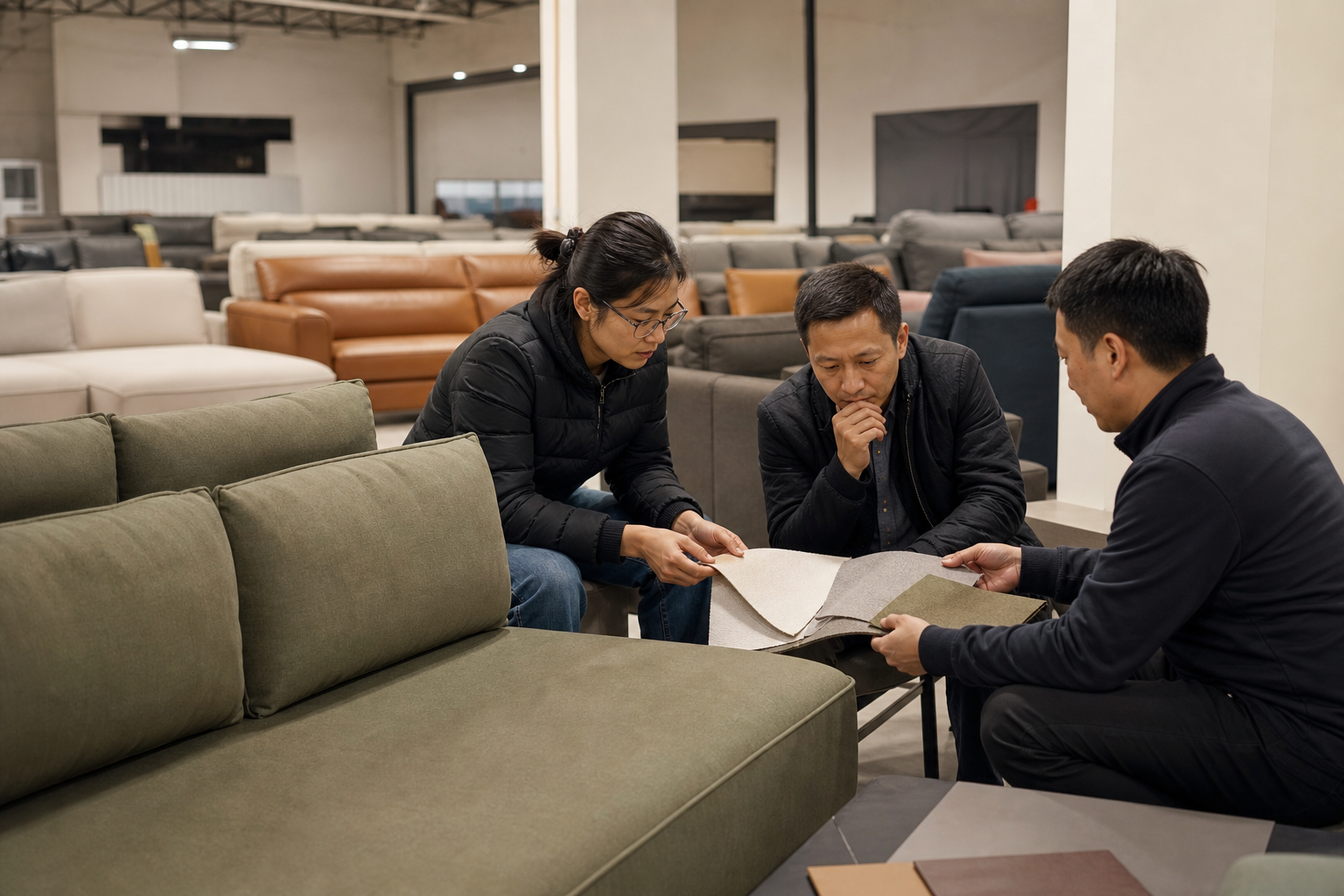
The mechanism is straightforward: retailers choose candidate styles they think might work locally, StarbornHub coordinates a small test run and delivery, the retailer captures real customer decisions (sits, reservations, walk-out purchase, objections), and that feedback flows back to factories and designers. Decisions to scale are therefore grounded in real demand signals rather than internal opinions.
A practical playbook for independent retailers
You don’t need to redesign your whole buying process overnight. Start with a few disciplined practices that reduce downside and accelerate learning.
1. Curate a shortlist based on local intuition. Pick 3–5 sofa concepts you believe could work in your market — note the specific hypothesis for each (e.g., “mid-century scale in 82" width will sell to urban two-bedroom households”).
2. Use small runs and in-store validation. Work with StarbornHub or a cooperative supplier to produce 3–10 units per style for testing rather than 50–100. Display them prominently and treat them as test SKUs.
3. Capture the right signals. Track reservations, conversion rates, average time from interest to sale, reasons for rejection, and price sensitivity. Ask follow-up questions: is fabric the blocker? Size? Price? Delivery time?
4. Convert learning into action. If a style sells quickly, scale production. If it attracts interest but fails at the price point, test a variant with a different spec. If it consistently underperforms, remove it and redeploy the space.
5. Share anonymized data through a cooperative mechanism. When multiple retailers report similar signals, the combined evidence lowers the risk of scaling and helps negotiate better production terms.
6. Keep logistics and delivery quality tight. A validated sale can still fail if delivery timing or installation undermines trust — so integrate reliable factory-side logistics in the plan.
Measurement matters: what to track
Treat this like a product development lifecycle, not an inventory listing. Key metrics to track during a test:
- Walk-in engagement rate (how many customers stop and sit).
- Reservation-to-sale ratio (reservations converted within a window).
- Sell-through rate in the test window (units sold / units displayed).
- Primary reasons for rejection (price, fabric, size, comfort, delivery).
Those signals tell you whether a product is heading toward scalable demand or heading for clearance. Use them to decide whether to order larger runs.
The bottom line
Customers, not designers or buyers, decide whether a sofa style will succeed. The worst strategic mistake is making large stock commitments before real customers have had a chance to validate the product. The best practical response is to build a repeatable validation loop: test small, measure customer behavior, and scale only after evidence.
StarbornHub is a mechanism built to make that loop affordable and reliable for independent retailers: low-MOQ runs, factory coordination, and a shared data approach that turns local signals into confident buying decisions. Do that, and you reduce slow-moving inventory not by clearing it faster, but by choosing better in the first place.
Conclusion
The best way to reduce slow-moving inventory is not only to clear it faster. It is to build a better product selection and validation mechanism before large stock commitments are made. For an independent furniture retailer, the point is not to accept a new supplier claim blindly. The point is to make the next product decision clearer before cash, showroom space, and customer trust are already committed.
More articles in this content module
Module: Product Selection Risk
This is the full reading map for the current content block, so you can follow the logic inside this topic before jumping to another issue.
- How do furniture retailers know which sofa styles will sell?
- How do furniture retailers know which sofa styles will sell?
- How do furniture retailers know which sofa styles will sell?
- How do furniture retailers know which sofa styles will sell?
- How do furniture retailers know which sofa styles will sell?
Other content modules you may want to explore
If your concern is not only this one issue, these modules open nearby paths in the StarbornHub theory system.
What this could improve if handled better: A positive business outcome or advantage the retailer may want.
What do local customers accept in size, price, comfort, color, delivery time, and style?
First reading in this module: How do I know what my local furniture customers actually want?
What it may take, cost, or risk: A decision concern about work, cost, risk, staff burden, or what the retailer might lose.
Validation And Small-Batch Testing
What should be validated before a larger stock commitment?
First reading in this module: Should furniture retailers buy stock before testing customer demand?
Why this path may be worth testing: A trust-building or low-commitment validation question.
Supplier Trust And Quality Responsibility
What incentive does the supplier have to protect quality after the first order?
First reading in this module: What should a furniture retailer ask before trusting a new sofa supplier?