
Factory Growth Depends On Retailer Customer Growth?
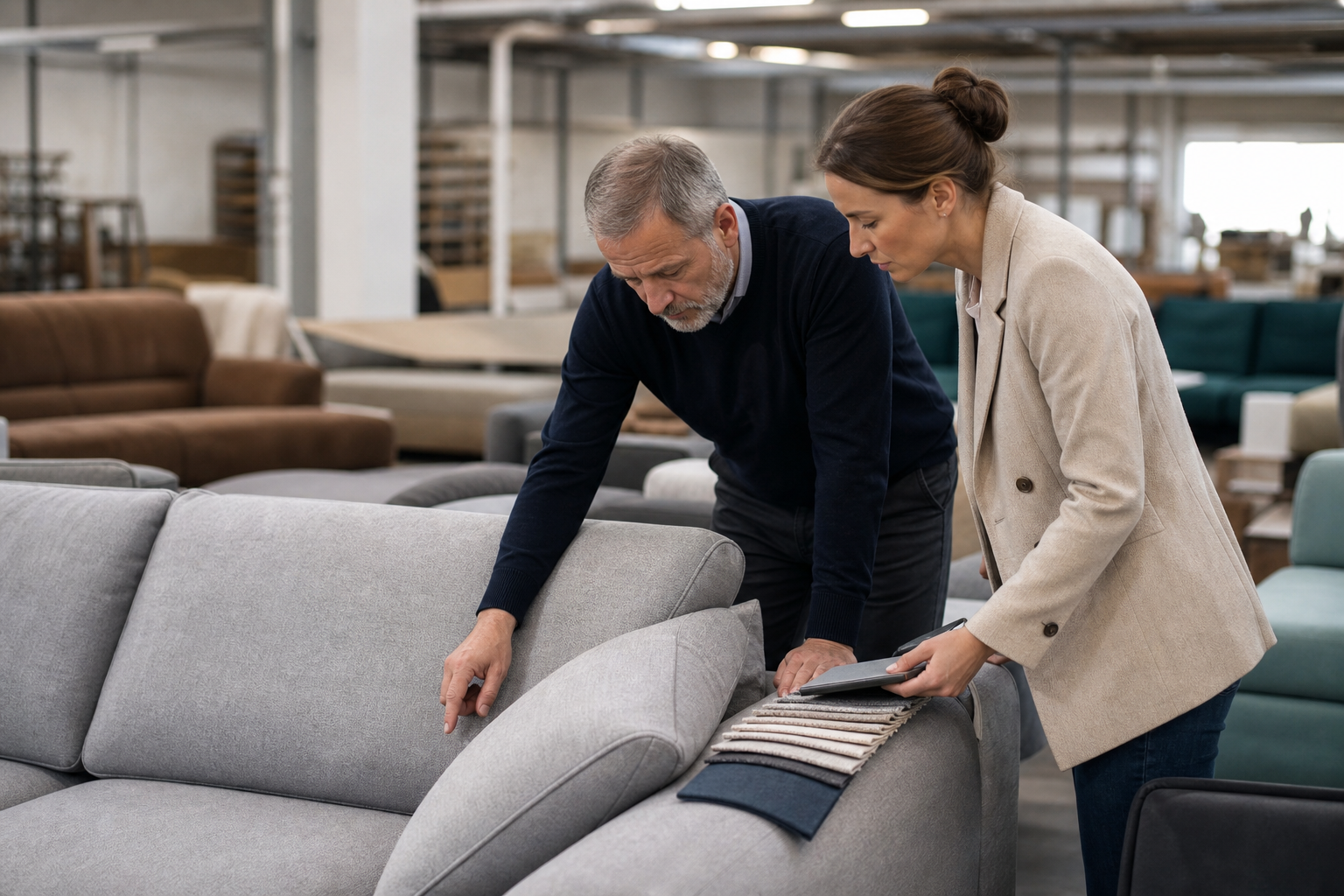
There’s a tight, uncomfortable moment every independent furniture retailer knows well: a new sofa design looks promising, customers react politely in the store, and the supplier offers a bulk price that makes financial sense only if it sells fast.
Do you spend limited cash to stock up now, or do you delay until you’ve built enough local evidence?
That question is the marketplace in miniature. The deeper truth StarbornHub’s model starts from is simple but often ignored: the real source of demand is the consumer, and the retailer is the critical translator between that consumer and the factory. When retailers—especially small, independent shops—turn their natural foot traffic into measurable, repeatable customer signals, factories can design supply and growth plans that actually match the market.

Demand flows consumer → retailer → factory
That ordering matters. A factory can ramp capacity, lower costs, or push more SKUs, but without adoption at the retail level those efforts don’t translate into sustainable orders. Retailers collect the direct signals: who walks in, what they try, what questions they ask, which finishes convert. Treating these signals as operational currency—rather than hoping production will create demand—is the strategic shift the theory recommends.
Why independent retailers are the lever
Large chains have scale and predictable replenishment patterns, but they’re slower to test new styles and less nimble for local differentiation. Independent retailers, by contrast, have a short decision chain, close customer connections, and the flexibility to try local variations quickly. That makes them effective validation partners: when supported correctly, their experiments turn into real orders that reflect local tastes, not just theoretical forecasts.
For retailers, this flips the risk equation. Instead of being asked to underwrite a factory’s forecast with large upfront buys, small shops can be empowered to lead with local evidence. When a retailer’s local signals carry weight, the path from sample to order becomes clearer and less risky.
What it means for factory strategy—and why retailers should care
Factories that succeed long-term will shift focus from pure manufacturing metrics toward the ability to help retailers grow their customer bases. Practically, that means factories invest in mechanisms that let retailers turn showroom traffic into durable assets: tracked customer relationships, repeat purchase pathways, and feedback loops that inform product development.
For retailers, the business logic is straightforward. If you can convert showroom interest into measurable accounts or repeat interactions, you gain leverage to negotiate better, safer supply terms. You’re turning a one-time visitor into a measurable asset—a customer you can remarket to, learn from, and use to validate future buys.
How StarbornHub operationalizes retailer-led validation
StarbornHub is designed as a platform cooperation mechanism backed by real factory capability that organizes factory supply and retailer touchpoints into a working learning system. It doesn’t hide the mechanism: it creates a set of tools and rules that help retail experiments scale into reliable signals without exposing precise internal policies publicly.
Key elements retailers will recognize and can use:
- Long-term value sharing: Instead of treating retailer effort as a one-off sale, the platform designs ways for retailers to capture ongoing value from customers they help develop. That means your time and local marketing are treated as investments with measurable returns, not sunk costs.
- User participation and quality filtering: Through participation incentives and staged voting or interest signals, the platform raises the signal-to-noise ratio of customer feedback. In practice this makes the votes and early trials you run more informative for product decisions.
- Account binding and virtual rights: Customers’ showroom interactions can be turned into account assets that carry virtual purchasing rights or credits. Those rights make it easier to convert interest into later sales and bind customers to your store without forcing you to front large inventory costs.
- Local protection and differentiation: The system supports city-level protections or limited local exclusivity so your sample displays and local marketing aren’t immediately undercut by other nearby shops carrying the same launch items.
- Flexible supply and sample support: The factory-side flexibility—short runs on fabrics, controlled sample production, and a pathway to incremental replenishment—reduces the cost of experimenting with new styles.
Together these mechanisms let a retailer run quick, low-risk validation loops: present a curated set of samples, convert customer interactions into measurable account assets, gather votes and repeat-interest signals, then escalate inventory commitments only after the signals are validated.
A practical path for retailers: validate before bulk ordering
Here’s a practical, business-focused sequence you can use in your shop.
1) Curate a small, testable assortment. Choose a narrowed selection of styles and finish options you believe might work in your market. Keep the sample set intentionally small so you can rotate displays.
2) Convert interest into accounts. When customers engage with a sample, capture a durable identifier—an account, a loyalty entry, or a virtual credit. This becomes the primary metric that indicates a relationship rather than a one-off browse.
3) Gather structured feedback. Use simple, repeatable signals—votes, preference selections, or recorded interest—that map directly to styles. The goal is data you and the factory can compare across stores and time.
4) Protect local investment. If possible, secure localized protections or first-mover visibility so your sample investment isn’t immediately replicated by a neighboring store.
5) Use virtual credits to trade time for certainty. Where available, apply virtual credits or deferred discounts that encourage customers to commit later. That reduces the need to push for an immediate cash sale while preserving future conversion potential.
6) Ask the factory for flexible support on replenishment. If the early signals look promising, request short replenishment runs or flexible fabric options rather than full bulk buys straight away.
7) Measure the right outcomes. Track conversion from account creation to purchase, repeat interest over time, and repurchase signals from the same accounts. Avoid over-weighting a single promotional spike as proof of long-term demand.
8) Scale inventory when local signals consistently repeat. Only after you observe repeatable, account-backed demand should you move to larger stock commitments.
What success—and failure—looks like
Success is not a single fast-selling launch; it’s a pattern. Retailers should look for consistent conversion from account to purchase, repeat inquiries about specific finishes, and data that aligns with in-store anecdotal feedback. Failure is often the result of mistaking transient traffic or promotional artifacts for durable preference.
That’s why StarbornHub treats this as a continuous validation process. Mechanisms like user quality filtering and account tracking are designed to reduce the chance of being misled by short-lived spikes. At the same time, the platform accepts that some tests will fail and that the factory needs to absorb part of the long-term value equation to make experimentation feasible.
Limits and risks to keep in mind
No mechanism eliminates risk. If your store cannot convert traffic into accounts or maintain customer follow-up, the validation loop breaks. Also, if sample customers are not representative of your broader base, their feedback can mislead product decisions. The right approach is to run small, rapid tests and treat the outcomes as evidence to iterate on, not as absolute truths.
StarbornHub intentionally retains principled boundaries: the platform focuses on mechanisms to enable validation without exposing back-end operational rules. For retailers, that means you get practical benefits—local protection, virtual credits, sample support—without needing to reverse-engineer platform economics.

From testing to commitment: a final practical note
If you have a limited budget for inventory, treat your first buys as learning capital rather than final allocation. Use curated displays, account capture, and short replenishment cycles. If you’re working with a factory or platform that offers flexible support, leverage it to convert early customer signals into safer, staged orders.
This takes discipline: don’t equate a single promotion or social post with durable demand, and don’t over-commit showroom cash before the customer-account pipeline starts to produce repeatable signals. When you follow a disciplined validation loop, factories are more likely to respond with reliable supply terms and deeper cooperation.

Conclusion
Independent retailers don’t need to gamble blindly on bulk purchases. The smarter path—backed by StarbornHub’s factory-retailer cooperation model—is to treat local customers as the primary growth signal. By converting showroom interest into measurable accounts, using staged participation mechanisms, and relying on flexible supply and local protections, you can validate styles with far less capital risk. The result: clearer buying decisions, better factory cooperation, and a steadier path from promising samples to profitable stock commitments.
More articles in this content module
Module: Validation And Small-Batch Testing
This is the full reading map for the current content block, so you can follow the logic inside this topic before jumping to another issue.
- Why does market pressure lead to the StarbornHub model?
- Why Independent Furniture Retailers Are the Best Validation Leverage
- Should furniture retailers test demand before buying deeper stock?
- What problem is StarbornHub really trying to solve for retailers?
- Why does StarbornHub challenge the traditional furniture supply chain?
- Why should furniture retailers validate demand before a bigger order?
- Local Customer Feedback and Safer Sofa Purchases: Turning Reports into Buying Decisions
- How much confidence should a retailer have before buying stock?
- Small-Batch Supply Reduces Retailer Stock Risk?
- Continuous Product Renewal Matters?
- The Operating Conditions Work Together?
- A Retailer Cannot Build This Mechanism Alone?
- Software Alone Cannot Solve Sofa Buying Risk
- What kind of system helps furniture retailers make safer buying decisions?
- Qualified Customer Registration Supports Buying Decisions?
- Monthly New Product Development Should Work?
- The StarbornHub Mechanisms Form A Loop?
- Inventory and Validation: Where to Draw the Line Before You Buy
- StarbornHub Uses AI Without Letting AI Decide Everything?
- AI Cannot Decide For Furniture Retailers?
- The StarbornHub Growth Flywheel Means?
- Platform Growth Must Serve Retailer Growth?
- Must Be True For The Flywheel To Work?
- StarbornHub Did Not Start From Software
- Factory Growth Depends On Retailer Customer Growth?
- StarbornHub Is Actually Trying To Validate?
- Retailers, Customers, And Factories Must Participate Together?
- StarbornHub Is Trying To Build?
- Kind Of Retailer StarbornHub Is Inviting?
Other content modules you may want to explore
If your concern is not only this one issue, these modules open nearby paths in the StarbornHub theory system.
Another problem retailers often connect to this: A nearby visible problem you may also be dealing with
Is the sales drop caused by fewer visitors, lower conversion, weaker product fit, local market pressure, or broader economic pressure?
First reading in this module: What changed in the furniture retail market?
What this could improve if handled better: A possible business gain behind this issue
Does the margin calculation include freight, delivery, damage, markdowns, financing, returns, and slow stock?
First reading in this module: How much margin room does an independent furniture retailer need?
What it may take, cost, or risk: The practical concern before trying a new path
Supplier Trust And Quality Responsibility
What incentive does the supplier have to protect quality after the first order?
First reading in this module: Quality Consistency Needs A Visible Process?