
Must Be True For The Flywheel To Work?

"Do I take the risk of buying bulk stock before I know whether customers in my market will buy, or should I wait until content and testing prove demand?" That question is exactly the practical tension StarbornHub was built to resolve — but only when a number of business conditions are met.
Treating local customer response as a practical buying signal is the core idea. If a platform simply collects likes and then ignores where those likes came from, you still carry the inventory risk. The flywheel works when local votes, samples and incentives are meaningful inputs to purchasing decisions and when the supply side can respond flexibly. Here’s what must be true for that to happen in your store.
1) Clear roles and executable incentive boundaries

A growth flywheel needs people who do real jobs, not abstract stakeholders. In a StarbornHub-style system that means factories, retailers, designers and in-store customers each carry responsibilities that are enforced by incentives that can actually be acted on.
- Factories underpin the rules, handle sampling and absorb early development work so retailers aren’t left carrying all the risk.
- Retailers bring natural foot traffic into a reproducible process: registering users, displaying samples, encouraging feedback and closing sales.
- Designers keep feeding new ideas so testing is continuous.
- Store customers provide the preference signals that should drive procurement.
This is about aligned expectations. Incentives must be structured around accounts and long-term value so short-term costs make business sense. When a retailer’s investment in customer cultivation is tied to ongoing returns (account-level value, long-term rewards, and local protections), they’re more likely to participate consistently. If you don’t have that alignment, customer feedback remains decorative rather than decisive.
2) High-quality, screenable in-store user samples that become long-term assets
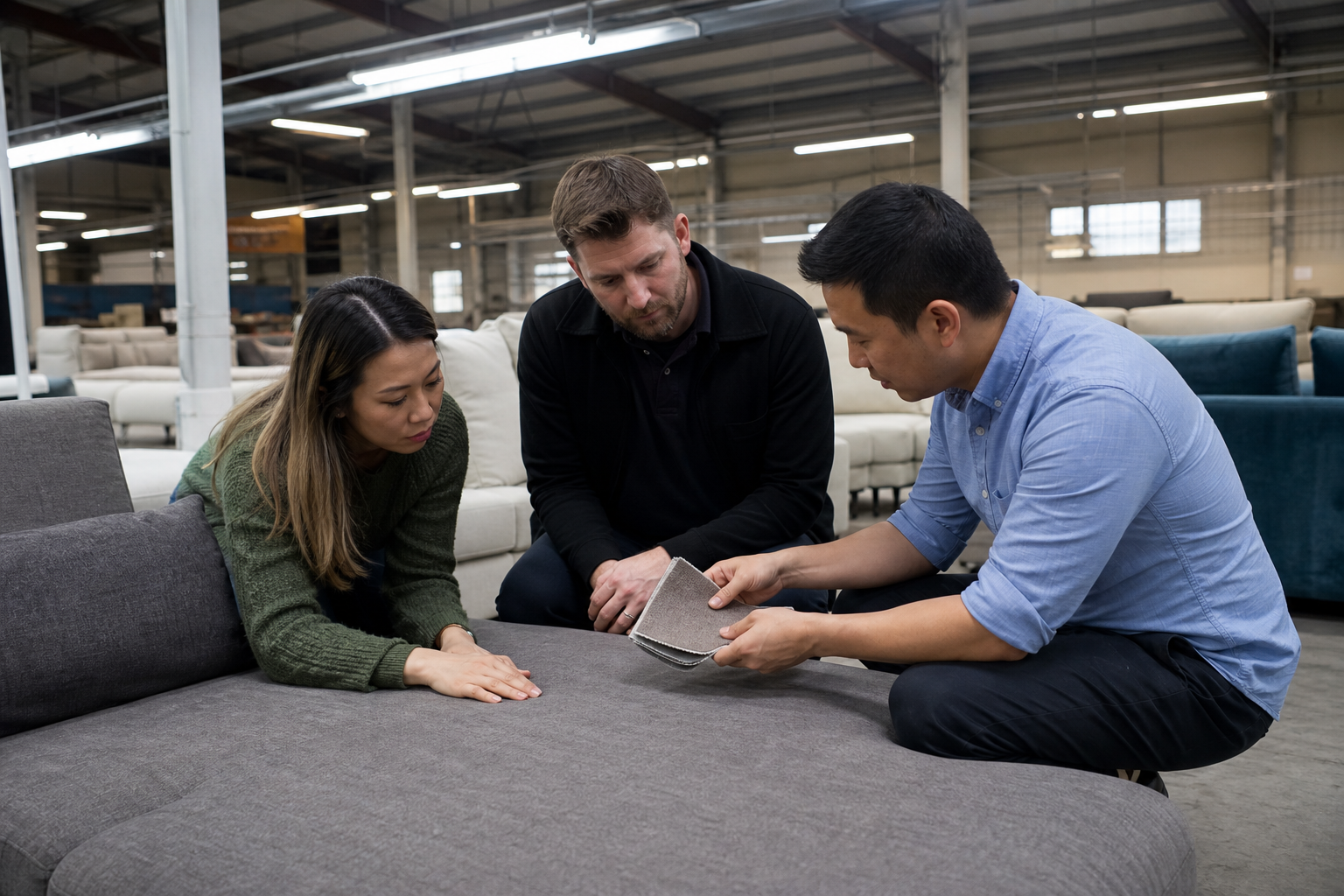
Random online clicks are noisy. For the flywheel to recommend buying decisions, signals must come from the right people — real potential buyers who visited your store and interacted with a sample. That requires two things: an in-store registration process that filters for genuine shoppers, and a mechanism that turns those interactions into a persistent, usable asset for the retailer.
A credible system amplifies quality by layering short-term incentives with long-term account value. participation history, long-term account-linked customer value or account bindings are not just promotional tricks; they convert transient visits into a persistent dataset you can read and act on when deciding what to buy next. If your store cannot reliably register and retain this kind of customer sample, feedback will be fragmented and unreliable.
Bottom line: before you bulk-buy, be sure you can capture and read high-quality local signals and that those signals are tied to customer accounts you can leverage for future selling and decision-making.
3) Retailer operating capability and long-term willingness to play the game
This is where many retailers get stuck. The flywheel is not a one-time experiment — it’s a repeated cycle that requires operational capability and a willingness to treat store traffic as a cultivated asset.
Operational capability means:
- Turning walk-in interest into registered interactions without damaging the shopping experience.
- Maintaining sample displays and handling small-batch fulfillment or exchanges connected to platform testing.
- Training staff to explain the value exchange to customers so votes or feedback are genuine.
Long-term willingness means you’re prepared to keep investing in local discovery even when early rounds look noisy. If a retailer treats the platform purely as a short-term source of product or as a quick-turn arbitrage channel, the local user asset will fragment and feedback will be unreliable. The platform favors retailers who can commit to the local nurturing that converts trial votes into repeat buyers.
If you’re asking whether to buy inventory now: check whether your store processes and team are ready to run this loop consistently. If not, bulk purchases are a bigger gamble.
4) Suppliers must be able to absorb sampling and deliver flexibly

Even with perfect local feedback, the flywheel breaks if supply can’t translate votes into producible SKUs at the right scale. That’s why a factory-side approach matters: factories that accept early-stage sampling costs, provide rapid development, and offer flexible minimums let retailers buy with much lower upfront exposure.
Key supplier capabilities that make the difference:
- Willingness to support initial sampling and iterative development so retailers don’t fund every test.
- A fabric and materials strategy that permits smaller or mixed orders without extreme cost penalties.
- Operational responsiveness so popular items can be produced and shipped in a cadence that matches local demand.
This is not a promise of unlimited concessions — it’s a managed flexibility designed to turn validated preference signals into real, sellable inventory without forcing a retailer into large, unsupported bets.
5) Institutional thresholds and local protections to make investment rational
A practical flywheel needs rules that reduce downside and silence destructive competition. That’s why entry thresholds, local protections and clear account ownership matter.
- Thresholds ensure that early samples are based on a sufficient volume of local signals so you’re not buying into noise.
- Local protections (city-level rights, account bindings, or similar mechanisms) protect the value retailers create by cultivating customers in their area.
- Clear long-term reward structures make it economically sensible for a retailer to invest in customer cultivation rather than flip products for one-time margins.
If those protections aren’t in place, the rational choice for many retailers becomes either buying anonymously and hoping for luck, or avoiding inventory risk entirely. The flywheel only turns when rules make local investment a business decision with predictable upside.
Practical checklist for retailers deciding whether to buy now or wait
- Can you capture and retain a measurable set of in-store interactions that reflect real buying intent? If not, defer bulk buying.
- Does your team have repeatable processes to convert foot traffic into registered feedback and to maintain sample displays? If not, build that first.
- Has the supplier agreed to flexible sampling and small-batch production that reduces your upfront risk? If not, negotiate or seek a platform-led cooperation backed by real factory capability.
- Are there account-level protections or local rights that make your investment in customer cultivation defensible? If not, clarify terms before large purchases.
- Are you prepared to treat these interactions as a growing local asset, not a one-off marketing stunt? If not, reconsider the timing.
These checkpoints help you avoid the classic trap: treating customer response as an afterthought and then blaming the market when inventory fails.
What StarbornHub brings to make this practical
StarbornHub is built as a platform cooperation mechanism backed by real factory capability that reduces the upfront risk retailers face when testing new products. We don’t replace the need for good in-store operations and genuine customer samples — we make the supply and institutional side manageable so validated demand can be turned into inventory without forcing retailers into oversized bets.
Our approach focuses on long-term value sharing, customer participation, user-quality filtering, account binding and local protection. That combination makes the local feedback you collect usable for procurement decisions and protects the retailer’s right to benefit from the customers they cultivate.
Conclusion
Buying bulk before you’ve validated local demand is a legitimate strategy only in the presence of four supporting conditions: clear participant roles and incentives, reliable in-store signal capture that becomes a long-term asset, retailer operational commitment, flexible supplier capacity, and institutional protections that make local investment defensible. When those pieces are in place, customer response becomes a practical buying signal rather than decoration — and the flywheel can move from preference data to real sales with manageable risk.
If you’re unsure which pieces are missing in your business today, start by auditing your in-store signal capture and supplier flexibility. Those two levers will quickly tell you whether to accelerate buying or to focus first on building a repeatable local discovery loop.
More articles in this content module
Module: Validation And Small-Batch Testing
This is the full reading map for the current content block, so you can follow the logic inside this topic before jumping to another issue.
- Why does market pressure lead to the StarbornHub model?
- Why Independent Furniture Retailers Are the Best Validation Leverage
- Should furniture retailers test demand before buying deeper stock?
- What problem is StarbornHub really trying to solve for retailers?
- Why does StarbornHub challenge the traditional furniture supply chain?
- Why should furniture retailers validate demand before a bigger order?
- Local Customer Feedback and Safer Sofa Purchases: Turning Reports into Buying Decisions
- How much confidence should a retailer have before buying stock?
- Small-Batch Supply Reduces Retailer Stock Risk?
- Continuous Product Renewal Matters?
- The Operating Conditions Work Together?
- A Retailer Cannot Build This Mechanism Alone?
- Software Alone Cannot Solve Sofa Buying Risk
- What kind of system helps furniture retailers make safer buying decisions?
- Qualified Customer Registration Supports Buying Decisions?
- Monthly New Product Development Should Work?
- The StarbornHub Mechanisms Form A Loop?
- Inventory and Validation: Where to Draw the Line Before You Buy
- StarbornHub Uses AI Without Letting AI Decide Everything?
- AI Cannot Decide For Furniture Retailers?
- The StarbornHub Growth Flywheel Means?
- Platform Growth Must Serve Retailer Growth?
- Must Be True For The Flywheel To Work?
- StarbornHub Did Not Start From Software
- Factory Growth Depends On Retailer Customer Growth?
- StarbornHub Is Actually Trying To Validate?
- Retailers, Customers, And Factories Must Participate Together?
- StarbornHub Is Trying To Build?
- Kind Of Retailer StarbornHub Is Inviting?
Other content modules you may want to explore
If your concern is not only this one issue, these modules open nearby paths in the StarbornHub theory system.
Another problem retailers often connect to this: A nearby visible problem you may also be dealing with
Showroom Space And Opportunity Cost
What better product, display, or customer conversation is blocked by the current slow-selling item?
First reading in this module: How much showroom space should a slow-selling sofa keep?
What this could improve if handled better: A possible business gain behind this issue
When does useful customer feedback arrive relative to the buying decision?
First reading in this module: Why does useful furniture customer feedback arrive too late?
What it may take, cost, or risk: The practical concern before trying a new path
Does the margin calculation include freight, delivery, damage, markdowns, financing, returns, and slow stock?
First reading in this module: How much margin room does an independent furniture retailer need?