
Why AI Makes Local Product–Market Fit More Important

If you run an independent furniture store, your daily headache isn’t whether a sofa looks ‘nice’ on Instagram — it’s deciding which sofa styles deserve the cash and showroom space that actually move units.
The rise of AI-generated design only makes that decision harder and more important. AI increases the supply of candidate designs, but it doesn’t tell you which ones your local customers will buy.
Below I’ll explain the business logic you need: what signals matter, why in-store customers and registered users are your strongest evidence, and how a platform like StarbornHub turns those signals into producible, testable commercial decisions without forcing risky inventory bets.
Put design into a local market coordinate system
Design is not an aesthetic exercise in isolation. The right question is not “Is this good design?” but “Which local market will accept this design enough to convert showroom traffic into sale and repeat business?” Markets can be cities, neighborhoods, or even a single store’s walk-in profile. Each has its own taste, price sensitivity, and customer journey.
That means your screening process must shift focus: from global beauty to local adoptability. A sofa that’s a hit in a trendy downtown loft district might be dead on arrival in a suburban family market. Screening needs to answer: does the design fit the local price band, lifestyle, and the path a buyer takes from discovery to checkout?
AI expands design supply — and the screening burden
AI gives us an unprecedented flood of variations and concepts. That’s a huge creative opportunity for retailers who can find winners. It’s also a trap: without a way to validate which of those thousands of generated variants map to local demand, most of that output becomes noise.
So you need two capabilities at scale. First, a way to push candidate designs quickly into real-world tests. Second, a way to ensure the tests themselves are rooted in local, comparable samples — not random online feedback that doesn’t reflect your in-store shopper.
If your screening funnel can’t handle many entrants and translate them into clear local signals, AI’s abundance becomes a distraction rather than a multiplier.
Stores and registered users are your most direct matching reference
Here’s the practical filter: the clearest evidence of local fit comes from your storefront and the people who actually walk through your door — supplemented by the registered customers you’ve cultivated.
- Store visitors naturally sit inside your local price and taste envelope. Their interest already reflects the context you operate in. Tracking which showroom samples get attention, sit-on time, enquiries, and conversion tells you more about fit than a thousand likes.
- Registered users are the next layer. When someone registers, votes, or engages more than once, their actions become durable signals. They’re not anonymous impressions; they are traceable behavioral patterns you can use to filter out one-off or fad responses.
Collecting and structuring those signals — which samples were tried, which designs earned registered votes, which visitors returned — gives you a comparable way to rank designs by local likelihood of success.

How StarbornHub turns design experiments into commercial paths
We built StarbornHub not to compete with the creative layer of AI, but to bridge AI-generated ideas and real-world retail outcomes. Practically, the platform maps candidate designs onto your local market tests and uses a set of business mechanisms to make the experiments actionable and low-risk.
Key elements you’ll recognize in daily use:
- Local experiment units: Candidate designs are routed into specific market tests — by city, by store, by customer cohort — so the feedback you get is directly comparable to your business context.
- Structured feedback from stores and users: Instead of raw social metrics, votes and behaviors collected in-store and from registered users are compiled into decision-ready reports that show how a design performed against local signals.
- Incentives that promote durable signals: Long-term value sharing and virtual incentives encourage users to participate repeatedly and improve the quality of feedback. That helps filter out noisy, one-time preferences.
- Account binding and local protection: Retailers who invest in local displays and customer cultivation are protected by mechanisms that reduce the risk of free-riding, so it’s worthwhile to commit showroom space to tests.
- Flexible, low-cost supply for winners: When a design proves it can attract and convert, the platform enables small-batch supply and rapid scaling without forcing a full inventory commitment up front.
These pieces form an execution loop: generate, test in local units, convert signals into a product decision, then move promising designs into small-batch supply and scale where appropriate.

That loop is the practical value of platform-led validation. It turns a yes-or-no aesthetic choice into a measurable, repeatable commercial decision.
What makes market matching commercially reliable — and where it breaks down
If you want to turn design experiments into revenue rather than noise, several commercial conditions need to be in place:
- Experiments must capture real purchase behavior or intent from real store visitors, not just broad online impressions. In-store signals align with the customer profiles you serve.
- Feedback needs quality control over time. Repeat engagement, history and behavioral filters (what customers actually did after showing interest) help avoid being misled by single-event enthusiasm.
- Retailers must have an incentive and the bandwidth to display samples and cultivate local users. Without that local effort, tests won’t reflect the on-the-ground economics of selling the product.
- The platform must be able to close the loop from voting to sample making to flexible supply. If tests identify winners but there’s no practical way to produce and deliver small batches quickly, the experiment is academic.
If any one of these is missing, you risk three problems: false positives (designs that look popular but won’t sell), false negatives (good designs that never get a fair local test), and wasted showroom real estate.
Practical steps for independent retailers
You don’t need to wait for a platform to start thinking this way. Here are operational moves that improve your odds of finding local winners:
- Treat your store as the primary market filter: log visitor interactions with specific samples, and track follow-up behavior for people who register.
- Encourage meaningful registration and repeat engagement: a single vote is noisy; a customer who returns or engages multiple times is valuable signal data.
- Run small, time-limited display tests before committing floor space permanently. Use short cycles to learn faster and free up space for new experiments.
- Prefer partners that can turn a local win into small-batch supply quickly. The ability to scale only after validation is the central risk-control strategy.
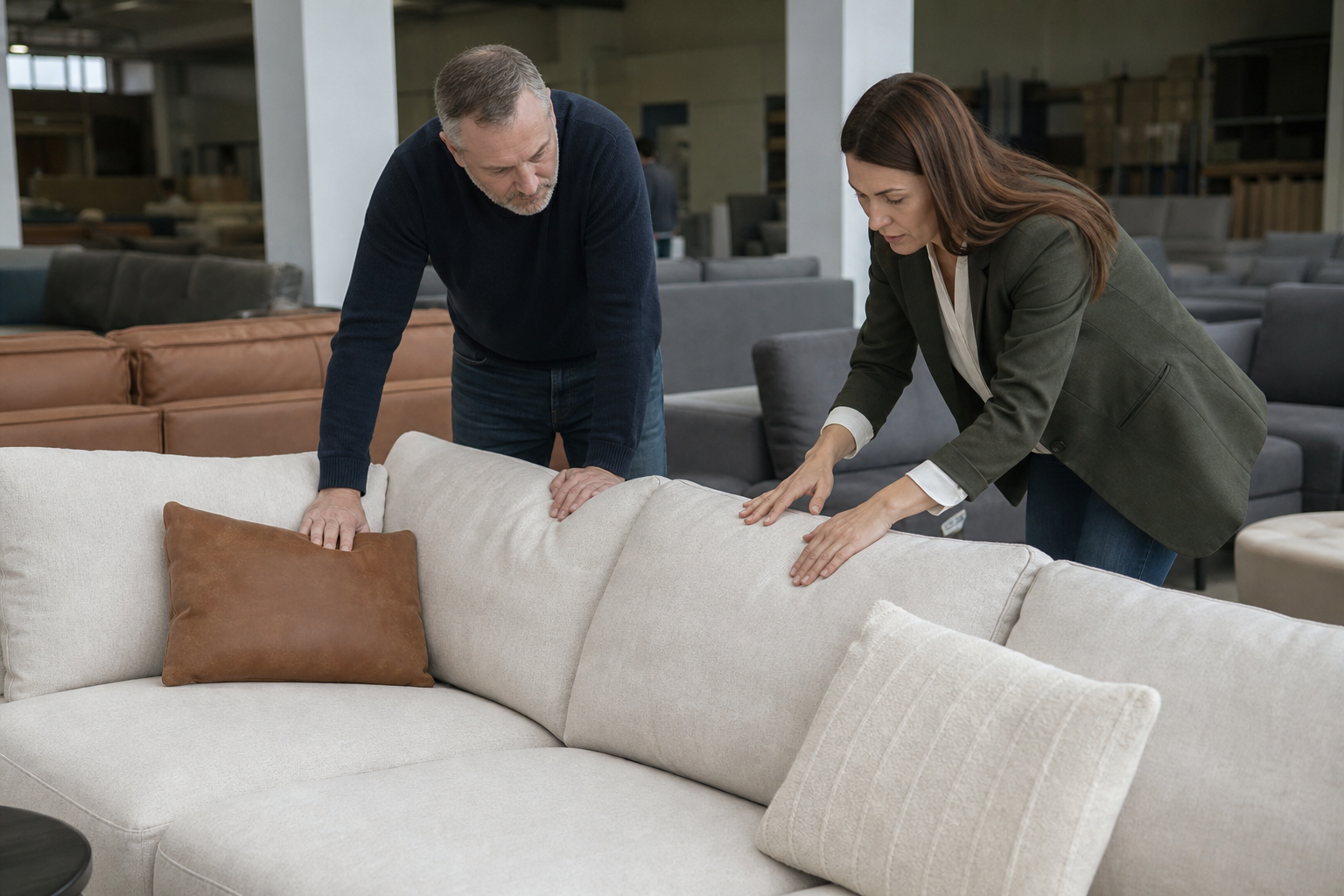
What this means for showroom and stocking strategy
Think of AI as an idea factory and your store as the measurement instrument. The business advantage goes to retailers who can connect the two: let AI broaden the candidate set, but use local, structured experiments to decide what actually deserves showroom space and stock.
That approach minimizes sunk cost in slow-moving inventory, reduces the risk of trend-driven mistakes, and builds a pipeline of locally validated SKUs that are more likely to generate sustained sales and repeat customers.
AI has also changed the attention environment around the retailer. It is now easier than ever for any business to produce images, posts, ads, emails, and product pages. That convenience is useful, but it also means the market is filled with more content, more similar messages, and more low-quality noise. For an independent furniture store, relying only on online exposure becomes more expensive and more random. The stronger path is to build a direct relationship with local customers, so the store is not waiting for a platform algorithm to decide whether the right customer sees the right product.
Conclusion
AI widens the pool of design possibilities, but it does not replace the need for local product-market fit. The practical work for independent retailers is to convert AI’s abundance into reliable, local signals: use in-store visitor behavior and registered user engagement as your primary evidence, run short, structured tests, and partner with platforms that turn local validation into low-risk supply. StarbornHub’s role is to provide the experimental and commercial scaffolding — incentives, account protections, and flexible fulfillment — that lets you test more, learn faster, and only scale those sofa styles that your neighborhood actually wants. Start treating design selection as a measurable market decision, and your showroom capital will work harder and safer for you.
More articles in this content module
Module: Local Market Signal
This is the full reading map for the current content block, so you can follow the logic inside this topic before jumping to another issue.
- How can an independent furniture store stand out without competing only on price?
- Faster Product Iteration and Local Customer Signals
- How has online comparison changed what furniture customers expect?
- How can a furniture retailer read its local market better?
- Why does local protection matter for independent furniture retailers?
- How can furniture retailers cooperate locally without competing on the same products?
- Why is local market intelligence more useful than national furniture trends?
- Using AI to Read Local Market Signals: Practical Steps for Independent Furniture Retailers
- What are the limits of market intelligence for furniture retailers?
- Why AI Makes Local Product–Market Fit More Important
- How does product-market fit become a growth flywheel for furniture retailers?
Other content modules you may want to explore
If your concern is not only this one issue, these modules open nearby paths in the StarbornHub theory system.
Another problem retailers often connect to this: A nearby visible problem you may also be dealing with
Does the margin calculation include freight, delivery, damage, markdowns, financing, returns, and slow stock?
First reading in this module: How much margin room does an independent furniture retailer need?
What this could improve if handled better: A possible business gain behind this issue
Supplier Trust And Quality Responsibility
What incentive does the supplier have to protect quality after the first order?
First reading in this module: Quality Consistency Needs A Visible Process?
What it may take, cost, or risk: The practical concern before trying a new path
Is the sales drop caused by fewer visitors, lower conversion, weaker product fit, local market pressure, or broader economic pressure?
First reading in this module: What changed in the furniture retail market?