
How can an independent furniture store stand out without competing only on price?
Too many independent stores think differentiation is a single product, a flashy display, or a temporary sale.
In reality, durable differentiation comes from being better at understanding and acting on your local market — again and again. Below I unpack why that matters, what kinds of advantages are hard to copy, and practical ways to build the local-market capabilities that actually protect margins and traffic.
Why similarity is getting more dangerous
Furniture assortments, fabrics, color palettes and price bands are converging. Manufacturers sell into many channels; trends spread fast; social media makes styles visible everywhere. When multiple stores in the same city carry similar items, customers stop seeing meaningful reasons to choose one over another. They default to the simplest signals: price, convenience, or an already-known national brand.
For independents that can’t outspend or match the logistics of big chains, the result is pressure to discount, which erodes margins and makes long-term investment in fresh assortments impossible.
Why price advantage is short-lived
Price is obvious and therefore easy to copy. One competitor’s discount can be matched within days. Even if you squeeze margin to win a sale now, you’ve weakened your capacity to pay for the real costs of a showroom business: samples, display rotation, staff training, and the working capital to experiment with new styles.
That’s not to say pricing isn’t important. It is. But it shouldn’t be the primary lever for uniqueness.
Resources versus advantage
Having access to a trade show, a supplier, or a line sheet is a resource. An advantage is what you do with those resources that others can’t easily replicate.
A local store’s foot traffic is a resource. Turning that traffic into a living database of who likes what — with reasons attached — is an advantage. The difference is organization: capturing signals and turning them into repeatable decision rules.
One-time hits don’t equal a moat
Selling a sofa that becomes a local hit is great — but it may be luck, timing, or a fleeting trend. The key question is whether you can reproduce that success with new introductions. If you can’t, you don’t have a sustainable advantage, you have a nice memory.
In practice this means shifting focus from 'which single SKU sells' to 'how do we increase our probability of selecting SKUs that sell across seasons and changing tastes?'. That shift requires systems: a way to collect feedback, test assumptions quickly, and adapt procurement decisions.
In sofas, copying is inevitable — so change is the real capability
Designs get copied. Suppliers will accelerate what sells. If your strategy depends on a design staying unique forever, you’ll lose. What’s defensible is the ability to change faster and better than competitors: to discover, validate, and introduce replacements that fit your local market.
A store with higher gross margins can afford to rotate samples and take product-development risks. But margins alone aren’t the full answer: you must have the processes and information to direct that investment efficiently.
Which advantages are hard to copy?
The most defensible advantages combine time, direct interaction with real customers, and a local lens. Examples:
- Systematic local market understanding (not national trend reports) — tied to housing stock, family sizes, and local lifestyles.
- Repeatable product-selection processes that match your customer profile, showroom footprint, and supplier capabilities.
- A tracked pool of local customer relationships and non-buyers you can re-engage.
- A feedback loop that converts what customers say and do into changes in buying decisions.
These are built over time and get stronger with use.
The capabilities worth building
If you’ll invest in anything, invest in four practical capabilities:
1) Market judgment: Know why customers from your city or neighborhood buy or hesitate. Capture details: common room sizes, preferred upholstery types, enduring colors, and friction participation history (e.g., delivery access, pet-proof fabrics). This is not high-level trend-chasing; it’s granular local intelligence.
2) Product selection: With limited showroom space and capital, choose SKUs that align with local needs and supplier realities (lead times, minimums, and customization options). Use a scoring rubric: match to typical living room, likely price band, fabric durability, and replenishment feasibility.
3) User-asset management: Turn visitors and unconverted prospects into assets. Collect contact permission, record objections or wishlists, and re-engage intelligently. Non-buyers are rich signal sources if you track why they didn’t buy.
4) Feedback loop: Make customer reactions (likes, dislikes, reasons) flow into purchasing decisions. Track sample performance by exposure hours, enquiry rate, and conversion, not just by occasional sales.
How StarbornHub helps — the practical mechanism
StarbornHub is a platform cooperation mechanism backed by real factory capability built to help independents turn those resources into real advantages.
At the practical level StarbornHub does three things:
- Low-commitment sampling and rotation: Factories provide a controlled way to bring new models into your showroom without forcing large inventory commitments. You test in place with real local exposure.
- Structured feedback capture: The platform encourages standardized signal capture — why a customer liked or rejected a piece, which room it would go in, what price mattered — so feedback is comparable and accumulates into usable patterns.
- Fast supplier response: Because StarbornHub is a platform backed by real factory capability, learnings from your showroom can translate quickly to small-batch adjustments, alternative fabrics, or minor dimensional changes that improve fit for local buyers.
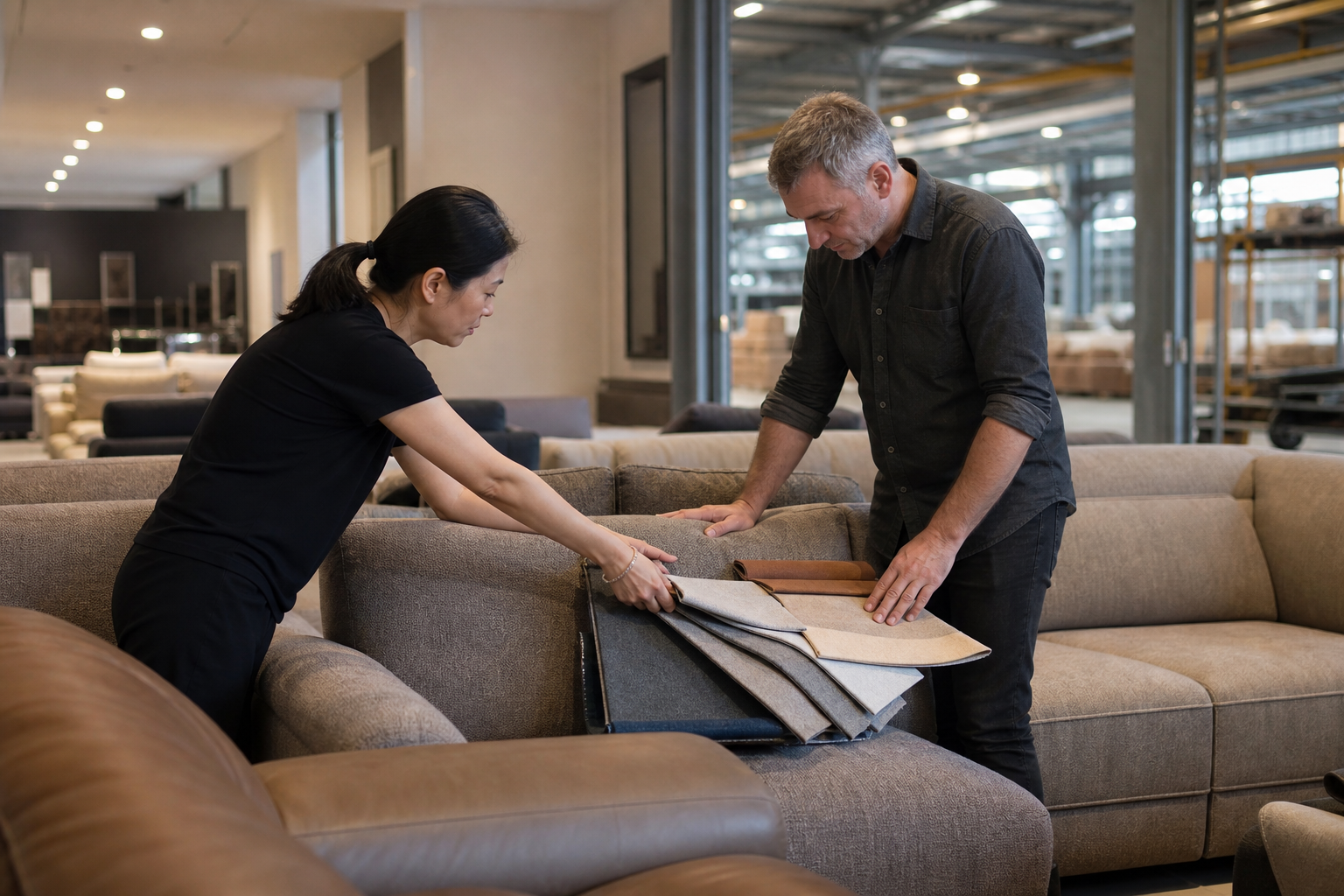
This isn’t outsourcing your taste. It’s about giving you the tools to test, learn, and convert those lessons into repeatable selection wins while keeping showroom risk manageable.
Practical first steps for retailers this week
- Start capturing reasons. When a customer says no, record the reason in a simple list: color/size/price/fabric/delivery. Do this for every meaningful encounter.
- Score existing samples. Create a 5-point scorecard (appearance fit, fabric fit, price fit, replenishment risk, margin) and score every display piece.
- Run two-week pilots. Put one new model on the floor for two weeks and measure exposure, enquiries, and outcome. If it doesn’t pass predefined thresholds, swap it promptly.
- Keep a prospect list. Offer to send updates or fabric samples to undecided customers. Revisit these contacts when a closer match arrives.
- Identify a feedback owner. One person should summarize signals weekly and make a recommendation: keep, modify, or replace.
- Talk to factories about short runs. If your feedback suggests a small tweak (a different seat depth or a pet-friendly fabric), a short run can validate that change without a heavy inventory bet.
Final takeaway
Differentiation for independents doesn’t come from being the cheapest or from a single product hit. It comes from converting everyday customer interactions into organized, repeatable decision-making: better selection, faster learning, and tighter supplier feedback.
StarbornHub exists to make that conversion practical: factory-side sampling, repeatable feedback capture, and a mechanism to translate local signals into supply-side changes. Build the systems that make your local knowledge an asset, and you’ll stop competing on price alone.

Start small, measure everything, and make the next buying decision based on accumulated local signals — not a hopeful guess.
The research also shows why differentiation cannot remain a slogan: independent retailers are asking how to compete with chains, online platforms, and changing customer expectations at the same time. If the only answer is a lower price, the retailer may win attention for a moment while weakening the margin and service base that make the store worth visiting.
Conclusion
StarbornHub is built around the idea that independent retailers need clearer product-selection signals before deeper sofa stock commitments. For an independent furniture retailer, the point is not to accept a new supplier claim blindly. The point is to make the next product decision clearer before cash, showroom space, and customer trust are already committed.
More articles in this content module
Module: Local Market Signal
This is the full reading map for the current content block, so you can follow the logic inside this topic before jumping to another issue.
- How can furniture retailers know what local customers actually want?
- How can furniture retailers know what local customers actually want?
- How can furniture retailers know what local customers actually want?
Other content modules you may want to explore
If your concern is not only this one issue, these modules open nearby paths in the StarbornHub theory system.
What this could improve if handled better: A positive business outcome or advantage the retailer may want.
Customer Asset And Relationship Capture
Are website visits, blog clicks, customer questions, and reviews being captured as usable signals?
First reading in this module: How do I turn online browsers into showroom visitors?
What it may take, cost, or risk: A decision concern about work, cost, risk, staff burden, or what the retailer might lose.
Validation And Small-Batch Testing
What should be validated before a larger stock commitment?
First reading in this module: Should furniture retailers buy stock before testing customer demand?
Why this path may be worth testing: A trust-building or low-commitment validation question.
Supplier Trust And Quality Responsibility
What incentive does the supplier have to protect quality after the first order?
First reading in this module: What should a furniture retailer ask before trusting a new sofa supplier?