
StarbornHub Starts From A Real Factory Base?
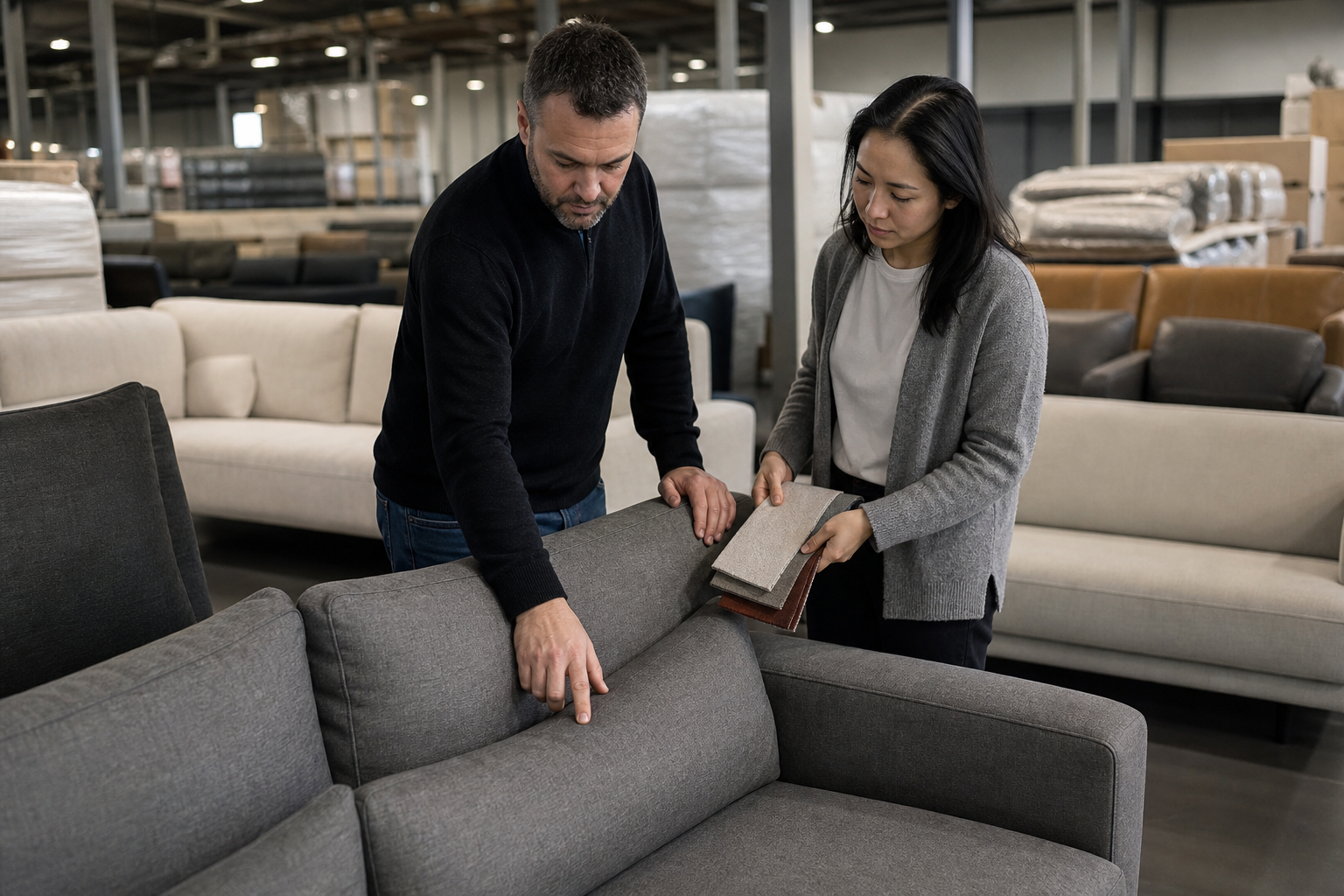
If you run an independent furniture store, you face a recurring problem: which sofa styles deserve showroom space and a real cash commitment?
Too often that decision rests on tidy samples, a designer’s portfolio, or a gut read from a rep — and those signals break down quickly once production, delivery and real shoppers enter the picture.
We built StarbornHub starting from a factory base because the factory perspective surfaces the hard constraints and decision participation history most buyers don’t see. That view doesn’t replace design taste or retail skill; it changes the inputs you should use when deciding what to stock.

Why the factory point of view matters for retailers
A factory isn’t just a place that executes orders. From design sketch to mass run, it lives through the practical chain that determines whether a product can be made, at what risk, and with how much iteration: prototype → sample iteration → small-batch trial → scale production. Each step exposes friction: material substitutions, tooling pain participation history, lead-time spikes, and unit-cost sensitivity.
When you judge a sofa only by its look on a sample or a showroom tag, you miss those upstream signals. A beautifully rendered design can become a margin trap if the factory needs exotic trims, tight tolerances, or repeated rework. Conversely, a design that looks conservative but aligns with a factory’s strengths can be a reliable performer. Starting from the factory helps you translate aesthetic judgment into predictable commercial outcomes.
The feedback gap that sinks risky launches
Traditional supply chains keep factories several layers away from real customer feedback. Factories optimize for cost, yield and delivery rhythm; they rarely see walk-in shopper choices, conversion rates, or which materials influence returns. The result is twofold: factories absorb cost when products fail at market, and upstream decision-makers — designers, buyers, and reps — make repeatable mistakes based on limited samples.
Closing that gap means introducing representative market evidence into the development chain. Not anecdotally, from one or two stores, but as an ongoing signal that informs whether a sample should be refined, scaled, or shelved.
What retailers should ask before trusting a new sofa supplier
When you evaluate a new supplier — especially a manufacturing-backed line — add these practical, market-grounded questions to the usual checks about quality and lead times. These questions come from the factory-to-market logic we describe above and reflect the mechanisms StarbornHub uses to reduce risk.
- How does the supplier validate a sample beyond your store? Ask whether they use representative customer feedback or local trial runs before committing to a full run. A supplier that relies on broader, recurring user input is less likely to put an unproven sofa into big production.
- Can this supplier support low-friction local trials? The ability to try a small pool of inventory locally, adjust based on shopper response, then scale if it works is a strong signal. It reduces your exposure and lets real customer behavior guide reorder decisions.
- How are customer responses captured and returned to product development? Look for mechanisms that convert shop visits, registrations, or simple local votes into usable feedback for the factory. If feedback loops are informal or episodic, the product still carries one-off risk.
- Will the supplier protect your local investment? Local protection or city-level coordination (not opaque exclusivity rules) keeps your investment in showing and testing products defensible. Ask about arrangements that recognize a store’s role in market validation.
- Do they tie showroom trials to longer-term retailer incentives? Sustainable cooperation treats early showroom trials as an investment, not a free sample. Seek partners who structure longer-term value sharing so that a store’s willingness to test becomes an asset rather than sunk cost.
- How flexible is production when a trial needs tweaks? Factories with a managed sample pool and flexible small-batch capacity let you iterate quickly. Ask about how easily the supplier will implement small practical changes informed by local feedback.
You won’t get perfect answers to all these on the first call. But suppliers that can demonstrate consistent mechanisms for capturing real customer response and linking it back to development are lower-risk partners.

Alexander James: a reminder that good ingredients aren’t enough
We often point to Alexander James’ experience as an instructive example: a respected designer, committed retailers and a capable factory still didn’t guarantee success because the product never endured representative market testing. That outcome isn’t a critique of designers or retail operators. It’s a reminder that decision-making must be institutionally supported.
StarbornHub’s approach is to institutionalize market validation so that product decisions aren’t left to single moments of judgment. That means building processes that let factories see customer preference data tied to real retail contexts, and letting retailers participate in shaping what gets scaled.
How a factory-initiated platform can change the game
There are practical levers a open platform backed by real manufacturing capability can operate to make product selection less risky for retailers.The detailed commercial rules belong in partner onboarding, not in a public article.
- Representative customer voting for samples. Instead of small-group opinions deciding the next run, broaden the signal by using representative voting or trials. That turns a subjective call into a trend you can test locally.
- Convert store traffic into trackable retail assets. Through registration and ongoing customer participation mechanisms, a store can build durable value beyond one-off transactions. This makes the economics of trialing new sofas more attractive.
- Maintain a managed sample pool and flexible supply. Retailers should be able to run low-cost, low-risk local tests and then scale rapidly if the results are positive. That flexibility reduces forced inventory decisions.
- Local protection and account binding. Where appropriate, structural protections recognize the store’s role in validating new lines, so a retailer’s investment in showing and market-building isn’t immediately cannibalized by other channels.
- Incentives that reward retailer contribution. Long-term value sharing — not a short-term bonus — encourages retailers to trial responsibly and feed quality signals back to the factory.
These are governance and operational mechanisms. Their point is to change who bears the cost of failed product-market fit and to turn single-shot decisions into iterative, data-informed choices.

Putting this into practice as a retailer
You don’t need to retool your entire buying process overnight. Start by asking prospective suppliers for concrete evidence that they: (a) run representative sample trials, (b) can support small local experiments without punitive minimums, and (c) have a repeatable mechanism for returning shopper behavior into design and production adjustments.
If a supplier resists those questions, treat that as a risk signal. If they have a platform-style approach — converting traffic into trackable value, protecting early testers, and enabling repeatable iteration — consider that a competitive advantage that will make your showroom dollars work harder.
Finally, remember that your store’s local knowledge still matters. A platform doesn’t replace retail judgment; it amplifies it. By choosing partners who can connect factory execution to real local feedback, you increase the odds that a sofa that looks right will actually sell and scale profitably.
Conclusion
Starting from the factory reframes the question of trust. It asks: can this supplier connect product execution with repeatable, representative market signals so you can make staged rather than all-or-nothing bets? For independent retailers, that capability matters more than glossy samples or single-store test results. Look for partners who institutionalize feedback, enable low-risk local trials, and share long-term value — those are the arrangements that let your showroom space and cash deliver consistent returns rather than one-off disappointments.
More articles in this content module
Module: Supplier Trust And Quality Responsibility
This is the full reading map for the current content block, so you can follow the logic inside this topic before jumping to another issue.
- Quality Consistency Needs A Visible Process?
- Fabric Choice And Custom Options Need Control?
- Wholesalers Struggle To Build This Mechanism?
- Large Factories Usually Avoid Retailer-Led Validation
- Smaller Factories Can Support Flexible Retailer Cooperation?
- Why Chinese Small & Mid-Sized Sofa Factories Work Better for Flexible Retail Partners
- Where Reliable Sofa Quality Really Comes From
- China Supply Chain Should Not Be Overpromised?
- Sofa Repair and Claim Options?
- First-Order Trust Connects With Quality Control?
- Two Similar Furniture Stores Can Become Different Over Time?
- StarbornHub Starts From A Real Factory Base?
- Roger's Factory Background Matters?
- StarbornHub Does Not Replace Independent Retailers?
- What should a furniture retailer ask before trusting a new sofa supplier?
Other content modules you may want to explore
If your concern is not only this one issue, these modules open nearby paths in the StarbornHub theory system.
Another problem retailers often connect to this: A nearby visible problem you may also be dealing with
Is the sales drop caused by fewer visitors, lower conversion, weaker product fit, local market pressure, or broader economic pressure?
First reading in this module: What changed in the furniture retail market?
What this could improve if handled better: A possible business gain behind this issue
Does the margin calculation include freight, delivery, damage, markdowns, financing, returns, and slow stock?
First reading in this module: How much margin room does an independent furniture retailer need?
What it may take, cost, or risk: The practical concern before trying a new path
Customer Asset And Relationship Capture
Are website visits, blog clicks, customer questions, and reviews being captured as usable signals?
First reading in this module: How account-linked benefits bring furniture customers back to the showroom