
The Operating Conditions Work Together?

Do you load the showroom with stock before you have proof the local market will buy, or do you wait until content and in-store trials produce clear demand signals?
That’s the tightrope independent furniture retailers walk: buy too much and your cash and floor space get stuck in slow-moving sofas; buy too little and you lose momentum and credibility when a style takes off.
StarbornHub’s operating thinking reframes this as a systems problem — not an inventory problem alone. The solution is to align short-term retailer costs with long-term, predictable returns, build a signal-driven supply chain that responds when styles test well, and turn walk-in customers into assets that inform buying decisions. Below I walk through the business logic and the practical mechanisms that make that possible for independent retailers.

Make room for short-term operating costs by showing a credible long-term path
One reason small retailers feel forced into big bets is simple: the visible costs of running a store — display pieces, staff time, sample rotation — are immediate, while the benefits of better assortment and customer development arrive later. The platform-level answer is to create a credible, tangible path from those early costs to later returns.
Practically that looks like arrangements which turn a store’s initial investments into predictable, ongoing value: customers who visit and register become a source of feedback for future buys; local protections and binding customer benefits reduce the risk that your display efforts are immediately undercut by a low-priced flyer online; and returns from successful styles are channeled back to participating stores so they see a follow-through benefit. When retailers can reasonably expect that the work of sample display and customer engagement pays off over time, they can afford the short-term carrying costs necessary to validate product-market fit.
Use supply rhythm to avoid big inventory bets
Inventory risks are two-sided: stockouts lose sales, overstock ties up cash. The alternative to guessing big is to make your ordering decisions signal-driven.
Think of supply rhythm as the matching mechanism between local demand signals — store feedback, customer votes, trial sits, and early sales — and factory response. The trick is to design an early-stage supply option that reduces the cost of being wrong (smaller batches, standard base materials) while allowing rapid scaling when a product proves popular (fast replenishment from factory-side stock). That keeps retailers from needing to place large, risky forward orders simply to avoid future shortages.
On the ground, this means negotiating smaller initial sample sets and reserving replenishment priority for items that show real traction. Retailers focus on experience and conversion; the platform and factory absorb production flexibility and speed. The outcome: fewer heavy upfront bets and faster recovery when a style becomes a local hit.

Turn in-store visitors into repeatable, monetizable signals
A visitor is not just a potential sale; they are a feedback point that helps you avoid the next slow-moving SKU. To make that shift, three things need to happen together:
- The store must be able to identify and register customers reliably so they’re more than anonymous foot traffic.
- Customer participation needs incentives — small rewards for voting, test-sitting, or leaving feedback — and those incentives must be tied into future procurement and rewards so customers keep engaging.
- The platform must ensure the data and votes meaningfully influence development and assortment decisions so retailers see the payoff of cultivating that audience.
When these elements are in place, a showroom visit becomes a measurable signal. You can test a new sofa with limited display pieces and a local campaign; the customer responses feed back to the factory and platform; and replenishment or expansion follows the signal rather than a guesstimated order. In short: customers become a low-cost prediction engine for buying decisions.
Protect the value you create in-store
One of the most painful dynamics for retailers is the ease of online price-comparison. If a buyer can find the same photo and a lower price elsewhere, the return on your display and service investment collapses.
You protect against that in two complementary ways. First, emphasize experiential differentiation: highlight what photos can’t show — touch, comfort, fit in a local living-room context, and staff expertise. Second, use platform-level protections that make local investment safer: city-level exclusivity, binding customer benefits, or other arrangements that reduce the effectiveness of simple picture-based comparison. These aren’t permanent monopolies; they’re designed to give the retailer space to justify higher, service-reflective prices and to recover sample and operating costs.
Together, experience plus institutional protection raises the floor on what a showroom investment can return.
Let the platform and factory carry supply complexity
Independent retailers don’t want to become logistics experts. The heavy lifting — product development, sampling, export documentation, consolidated shipping, and door-to-door fulfillment — is costly and risky if handled in-house.
That’s why the platform should present those services as ready-made modules. Retailers’ interactions are simple and actionable: review a localized vote report, select styles and materials from curated options, confirm quantities, and agree on delivery timing. All other complexity sits on the platform and factory side. This lowers the cognitive load for store owners and increases the likelihood they will use the validation system instead of reverting to big, conservative buys.
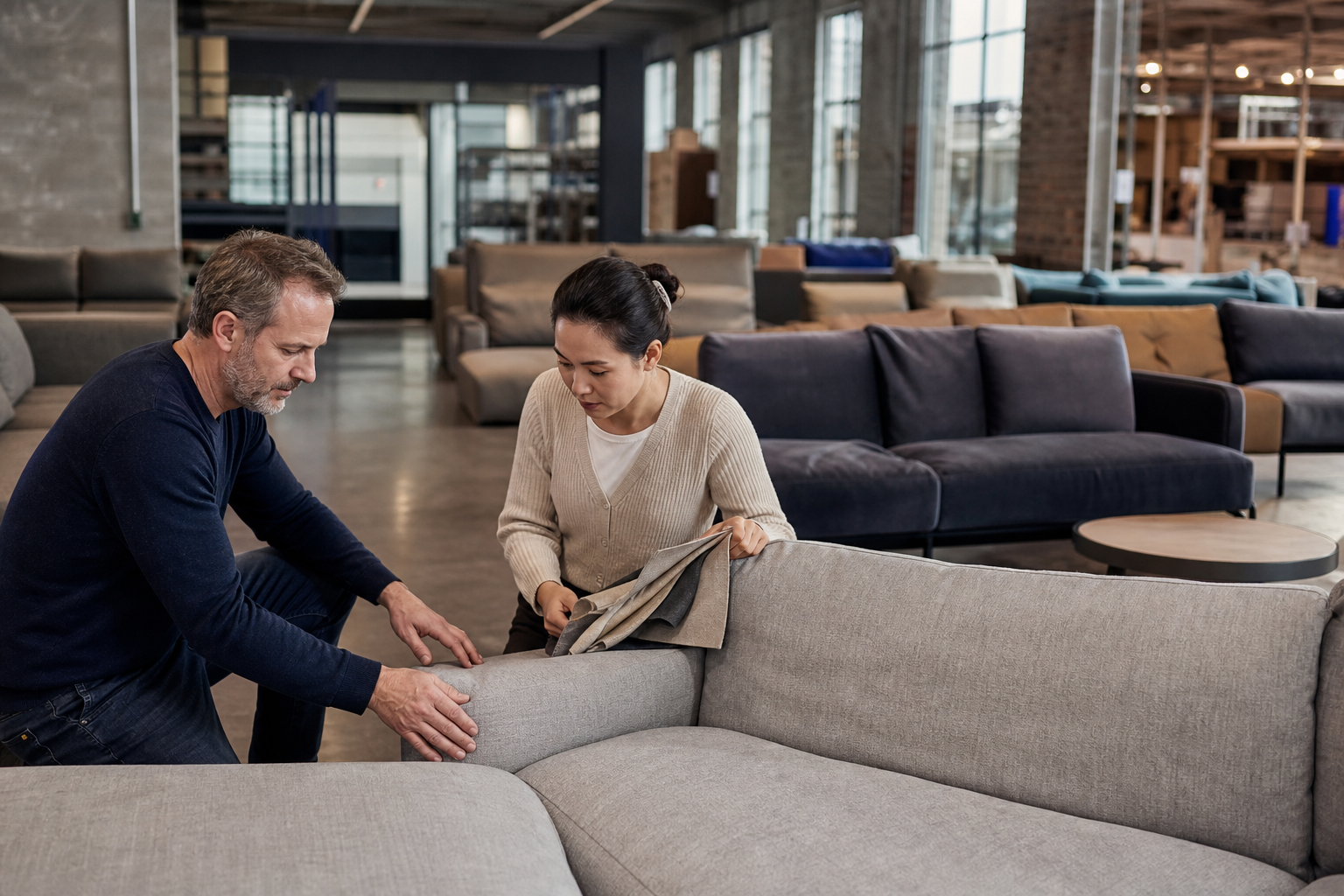
What to do with your next buying decision
If you’re asking whether to buy bulk inventory now or wait, reframe the question into smaller, directional steps you can execute this season:
- Start with a focused, small set of displays chosen to test specific local preferences rather than a broad collection. Use your floor to validate, not to hedge.
- Register walk-in customers and create a simple, incentivized way for them to give preferences. Treat that feedback as a buying input, not just marketing noise.
- Work with platform-backed suppliers who can offer a low-barrier first supply and rapid follow-up when signals emerge. Make sure replenishment speed and flexible production are part of the relationship.
- Protect your showroom value through experiential messaging and local arrangements that make your displayed products harder to undercut by a simple image search.
- Track the cost of carrying displays against the expected long-term return from repeat customers and improved buying accuracy. The short-term carrying cost is an investment in reducing future slow-moving inventory.
These steps let you move from binary choices (bulk or nothing) to an iterative buying process that reduces overall risk while preserving upside.
A note on platform economics and trust
Platforms like StarbornHub are platform cooperation mechanism backed by real factory capabilitys designed to align incentives across the local retailer, the customer, and the factory. They accomplish that through long-term value sharing, customer participation programs, local protection mechanisms, and making supply capability directly usable by retailers. The goal is not to replace retailer judgment but to amplify it with market signals and operational muscle. Retailers still control in-store experience and final assortment decisions — they simply receive better, lower-risk supply options and clearer evidence to buy on.
Conclusion
Slow-moving sofas are a symptom of making big buying bets without sufficient local validation. The practical alternative is to make short-term store costs a rational investment by converting customers into repeatable signals, keeping supply flexible and fast, and using platform-backed protections to preserve the value of your showroom work. In practice, that means smaller, targeted displays; registered customer feedback tied to procurement; factory-side replenishment when styles prove popular; and institutional protections that make the retailer’s investment pay off over time. If you want to reduce inventory drag, start by changing how you validate and order — not just how you discount.
More articles in this content module
Module: Validation And Small-Batch Testing
This is the full reading map for the current content block, so you can follow the logic inside this topic before jumping to another issue.
- Why does market pressure lead to the StarbornHub model?
- Why Independent Furniture Retailers Are the Best Validation Leverage
- Should furniture retailers test demand before buying deeper stock?
- What problem is StarbornHub really trying to solve for retailers?
- Why does StarbornHub challenge the traditional furniture supply chain?
- Why should furniture retailers validate demand before a bigger order?
- Local Customer Feedback and Safer Sofa Purchases: Turning Reports into Buying Decisions
- How much confidence should a retailer have before buying stock?
- Small-Batch Supply Reduces Retailer Stock Risk?
- Continuous Product Renewal Matters?
- The Operating Conditions Work Together?
- A Retailer Cannot Build This Mechanism Alone?
- Software Alone Cannot Solve Sofa Buying Risk
- What kind of system helps furniture retailers make safer buying decisions?
- Qualified Customer Registration Supports Buying Decisions?
- Monthly New Product Development Should Work?
- The StarbornHub Mechanisms Form A Loop?
- Inventory and Validation: Where to Draw the Line Before You Buy
- StarbornHub Uses AI Without Letting AI Decide Everything?
- AI Cannot Decide For Furniture Retailers?
- The StarbornHub Growth Flywheel Means?
- Platform Growth Must Serve Retailer Growth?
- Must Be True For The Flywheel To Work?
- StarbornHub Did Not Start From Software
- Factory Growth Depends On Retailer Customer Growth?
- StarbornHub Is Actually Trying To Validate?
- Retailers, Customers, And Factories Must Participate Together?
- StarbornHub Is Trying To Build?
- Kind Of Retailer StarbornHub Is Inviting?
Other content modules you may want to explore
If your concern is not only this one issue, these modules open nearby paths in the StarbornHub theory system.
Another problem retailers often connect to this: A nearby visible problem you may also be dealing with
Customer Asset And Relationship Capture
Are website visits, blog clicks, customer questions, and reviews being captured as usable signals?
First reading in this module: How account-linked benefits bring furniture customers back to the showroom
What this could improve if handled better: A possible business gain behind this issue
Is the sales drop caused by fewer visitors, lower conversion, weaker product fit, local market pressure, or broader economic pressure?
First reading in this module: What changed in the furniture retail market?
What it may take, cost, or risk: The practical concern before trying a new path
Traffic And Conversion Diagnosis
Is the store missing traffic, or is the existing traffic not converting?
First reading in this module: What is the operating formula behind an independent furniture store?