
How fast should a retailer replace a sofa style that does not move?

Slow-moving inventory is more than a line on your balance sheet: it steals floor space, salesperson attention, and the opportunity to show higher-margin merchandise.
The instinct to markdown and clear is valid, but it only addresses the symptom. At StarbornHub we’ve found the practical lever that delivers sustained improvement is a predictable, fast replacement capability combined with smarter pre‑commitment validation. That combination lets retailers keep their showroom productive without gambling on large, slow-moving assortments.
Below I’ll walk through the business logic and the operational mechanisms that make rapid, low-risk replacement work for independent retailers.
Move from show-cycle bursts to continuous replacement
Traditionally furniture supply follows an exhibition rhythm: new collections drop around trade shows, and the showroom gets refreshed in semiannual waves. The problem is the rhythm itself. It creates peaks of fresh stock followed by long tails of styles that don’t match local demand.
The alternative is a continuous, feedback-driven supply rhythm. When the factory and platform are the same cooperative structure—as StarbornHub is—you can shorten the loop from customer signal to sample to small-batch production. That means a style that clearly underperforms in a market can be retired from a specific showroom quickly rather than occupying space for months.
This doesn’t mean constant chaos; it means controlled, short-cycle iterations. The combination of customer signals, small-batch runs and accessible replacement SKUs lets you keep the showroom constantly aligned to what local customers buy.
Configure showrooms around unit-area margin and turnover
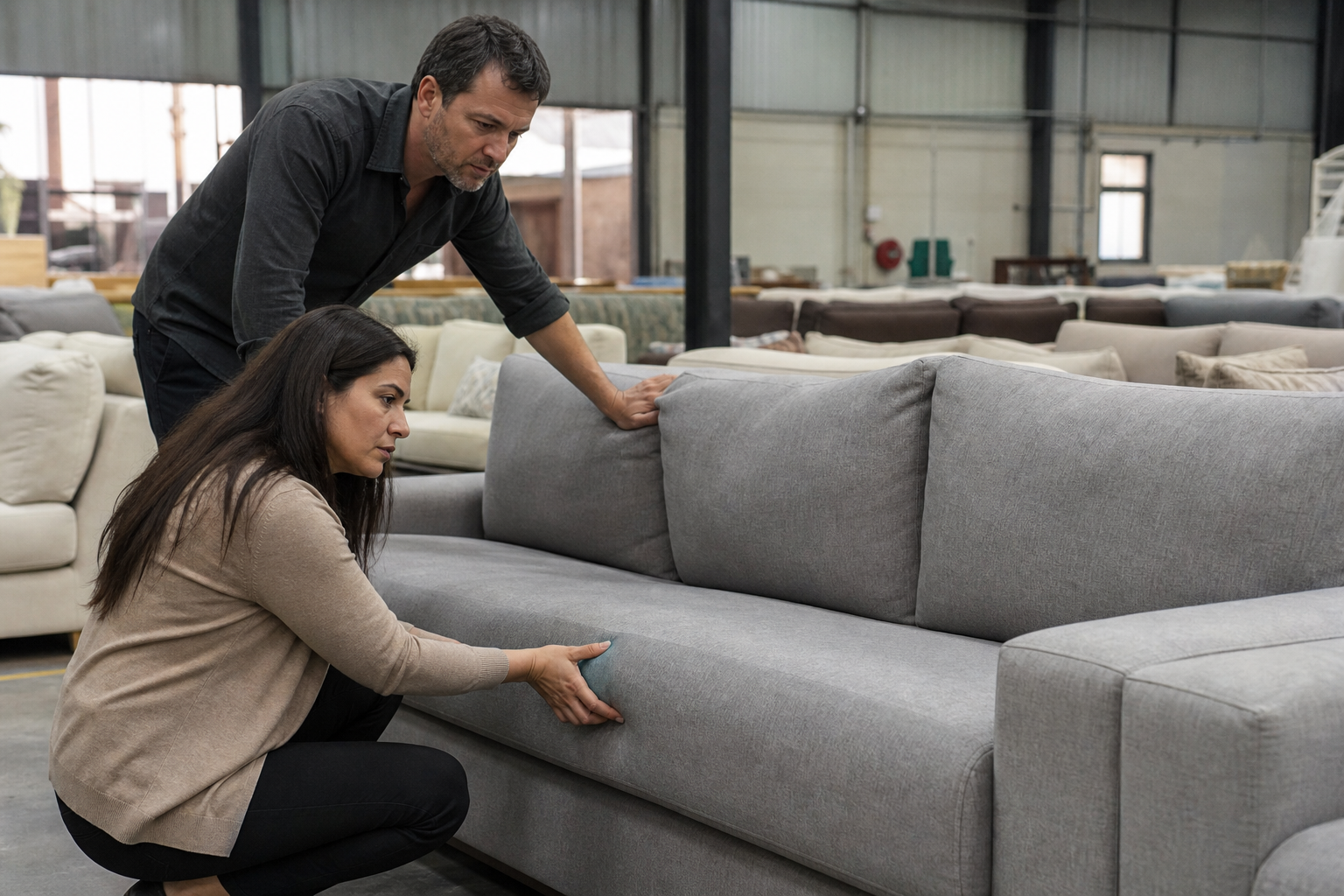
Every square foot of display has an opportunity cost. A single static couch that won’t sell not only fails to contribute margin, it actively reduces the store’s potential.
A practical way to think about replacement decisions is to tie them to unit-area margin: how much gross profit can that displayed position generate per unit area over a fixed period. If a style is generating below the threshold, it’s a candidate for replacement. But replacing it only makes sense if you can bring a viable alternative into the space without long empty gaps.
That’s where the platform must act as an enabler: provide local reports, quick replacement SKU options, and a supply channel that minimizes display downtime. The retailer remains the final arbiter of which replacement best suits their customers, but the platform supplies a manageable menu of alternatives and the logistics to make the swap fast.
Flexible supply and SKU management you can execute
Quick replacement relies on three practical foundations:
- Clear SKU definition and library management (style + fabric as the SKU unit), so ordering and substitution are straightforward.
- A pool of commonly stocked fabrics and a mechanism that allows low‑quantity ordering without exposing the retailer to outsized lead-time or cost risk.
- Factory capacity and routines for rapid sampling and small-batch production.
StarbornHub’s approach is not to explode SKU count indiscriminately. Instead, we keep a reliable fabric pool, validated quality controls and compliant product information. On top of that we make a subset of options available for low-quantity ordering so a retailer can swap a showroom sample with little procurement friction.
The platform also helps by absorbing early sampling and development costs and making inventory and production visibility available to the retailer. That lowers the risk of trying a replacement sample in the showroom.
Data-driven replacement decisions: tie user assets to product lifecycle
Decisions about removing or replacing a sample should not be based on gut feeling alone. Use three levels of data:
- Platform-wide voting trends to see macro-preference shifts.
- City/region feedback to pick up local taste differences.
- Store-level vote and transaction data to judge in-store convertibility.
StarbornHub closes the loop by converting user engagement (votes, registered activity, and engagement incentives) into meaningful lifecycle signals. If a style shows weak signals across these layers, the system flags it for replacement. The important difference is that these are not marketing metrics in isolation; they become inputs to product lifecycle management so the store can act confidently.
That same loop helps retailers evaluate candidate replacements: a suggested SKU backed by positive platform and city-level signals is a lower-risk swap than a new, untested piece.

Display samples and city protection: align incentives and reduce exposure
Retailers are understandably protective of the investment in showroom samples. They need assurance that putting time and money into developing a user base around a sample will not simply allow another nearby partner to monetize that same style.
City protection is the mechanism that allows retailers to take this risk. When a style is protected within a city, the retailer who invests in that sample can develop local customers without immediate overlap from another partner. Replacement workflows must respect that protection: when a store withdraws a sample because it’s underperforming, the platform manages that change so it doesn’t accidentally violate protection rules.
At the same time, the platform provides practical replacement paths: choose an alternative SKU from the commonly stocked fabric pool, use platform-supported sampling resources, or reallocate nearby inventory to cover display gaps. That means the retailer can remove an underperforming style and have a replacement in the space quickly, protecting unit-area margin and customer experience.
Putting the pieces together: an operational checklist for rapid replacement
These are the practical steps retailers should take to make rapid replacement work
1. Treat display positions as margin-generating assets. Monitor unit-area margin and set replacement thresholds.
2. Work with the platform to understand local and city-level reports. Use those signals before making large buys.
3. Maintain a short list of replacement-ready SKUs from the platform’s fabric pool. Prefer options that the platform can source on low quantities.
4. Use platform-supported sampling and small-batch options so you can test replacements without large inventory commitments.
5. Ensure the platform’s production visibility and local protection rules are clear so you know the risk profile of any swap.
6. Close the feedback loop: track how replacement SKUs perform and feed that data back into future selection decisions.
That checklist reduces financial exposure and keeps your showroom content aligned to current buyer preferences without heavy administrative overhead.

What to expect from a platform cooperation mechanism backed by real factory capability
When the platform has real factory capability behind it, you get practical advantages: shorter sample lead times, factory commitment to small initial runs, and clearer lines of accountability when a replacement is needed. StarbornHub uses those structural advantages to underwrite the flexible processes above, but that doesn’t mean unlimited flexibility. Expect reasonable controls around quality, delivery and cost boundaries—those controls preserve long-term value for both retailers and makers.
Operationally, this looks like:
- A curated set of fabrics and SKUs that are purposely kept available for low-quantity orders.
- Platform support for early sampling and initial development, reducing upfront cost for the retailer.
- Transparent production and inventory visibility so retailers can plan showroom swaps without unpleasant surprises.
These features allow you to act quickly and predictably, which is the point: speed without chaos.
How fast is 'fast' in practice?
Speed is relative to your market, but the business rule is simple: replace a sample as soon as the data shows persistent low conversions across store, city and platform levels and you can secure a replacement that minimizes display downtime and risk. The better your pre-commitment validation—platform voting, localized signals, and small-batch testing—the less often you’ll need emergency replacements.
In short, fast is not an emotional sprint; it’s a predictable cadence enabled by data, flexible supply and sensible local protection.
Conclusion
Clearing slow-moving inventory quickly helps, but the real win is preventing large, long-term commitments to styles that don’t match local demand. Do that by shifting from show-driven refreshes to continuous, data-led replacement; by treating display area as a margin asset; and by partnering with a platform that provides flexible, flexible factory-side supply capability, a curated fabric pool, and clear city protection. When those pieces work together, replacement becomes a routine, low-risk business decision—one that returns showroom space to its job: generating sustained margin and building local customer relationships.
If you’re a retailer, start by asking your platform for city- and store-level signals you can act on, and identify a short list of replacement-ready SKUs you can access quickly. That combination is the practical foundation of faster, smarter turnover.
More articles in this content module
Module: Slow-Moving Inventory Diagnosis
This is the full reading map for the current content block, so you can follow the logic inside this topic before jumping to another issue.
- Why is slow-moving inventory more than an inventory problem?
- Why slow-moving stock is riskier today — and how small-batch sourcing fixes it
- How fast should a retailer replace a sofa style that does not move?
- Where the retailer growth flywheel breaks — and how that stops slow-moving furniture
Other content modules you may want to explore
If your concern is not only this one issue, these modules open nearby paths in the StarbornHub theory system.
Another problem retailers often connect to this: A nearby visible problem you may also be dealing with
Customer Asset And Relationship Capture
Are website visits, blog clicks, customer questions, and reviews being captured as usable signals?
First reading in this module: How account-linked benefits bring furniture customers back to the showroom
What this could improve if handled better: A possible business gain behind this issue
Validation And Small-Batch Testing
What should be validated before a larger stock commitment?
First reading in this module: Why does market pressure lead to the StarbornHub model?
What it may take, cost, or risk: The practical concern before trying a new path
Is the sales drop caused by fewer visitors, lower conversion, weaker product fit, local market pressure, or broader economic pressure?
First reading in this module: What changed in the furniture retail market?