
How much showroom space should a slow-selling sofa keep?

If a sofa is slow to sell, it’s easy to blame the style, the price, or sales execution.
What’s harder to see — and what actually matters most to a small retailer — is the opportunity cost: what you gave up by committing that floor space, that sample, and that buying cash to this one SKU instead of another.
Retailers can see what they chose and the result. They cannot, in the same moment and under the same conditions, see how a different choice would have performed. That invisibility makes decisions feel risky and learning painfully slow. Below I’ll explain why the cost is invisible, why standard A/B testing doesn’t work well in furniture, and then offer a practical decision framework you can use today — including how StarbornHub’s local-signal approach reduces risk before you fully commit.

Why you can’t reliably see the opportunity cost
- Every buying decision is both selection and exclusion. When you choose sofa A you give it display space, sales time, a sample piece, and an opportunity to create a sale. At the same time you exclude B, C and D from the same resources — and those excluded items never get a chance to show what they could have done.
- You can’t rewind a market. A store can’t present six alternative sofas to the same customers at the same time, under the same conditions. Time, traffic, marketing and local events differ. So a good outcome for A doesn’t prove it was the best option — it just proves it worked under the conditions you gave it.
- Physical constraints amplify the invisibility. Showroom space is finite. A sample on the floor denies others a chance to be seen. Limited budget makes it impossible to buy and test every promising SKU. Each heavy test (sample, display, logistics, sales cycle) is costly and slow.
- Local differences matter. Cities, customer mix, store locations, and local competition change outcomes. What sells well in one city or store can underperform in another even for the same brand.
- Real A/B testing is hard. Digital businesses can duplicate and iterate cheaply. In furniture, launching a competing sofa is not just a copy of a webpage — it’s a physical sample, space, staff training, and weeks or months of exposure.
These structural factors mean most judgment in furniture retail is based on visible results for selected SKUs, with the invisible alternatives left to guesswork.
Why local customer response is the best practical signal
Because you can’t test every option simultaneously, the most reliable substitute for true counterfactuals is local customer behavior. Does your sofa draw shoppers, invite trials, generate quotes or reservations, or lead to conversations at checkout? Those are practical, early buying signals — not decorations after a decision.
StarbornHub treats those local signals as the meaningful inputs they are. Rather than forcing you to buy large inventory first, we help you surface how customers actually react in your market so you can make a smaller, clearer bet.
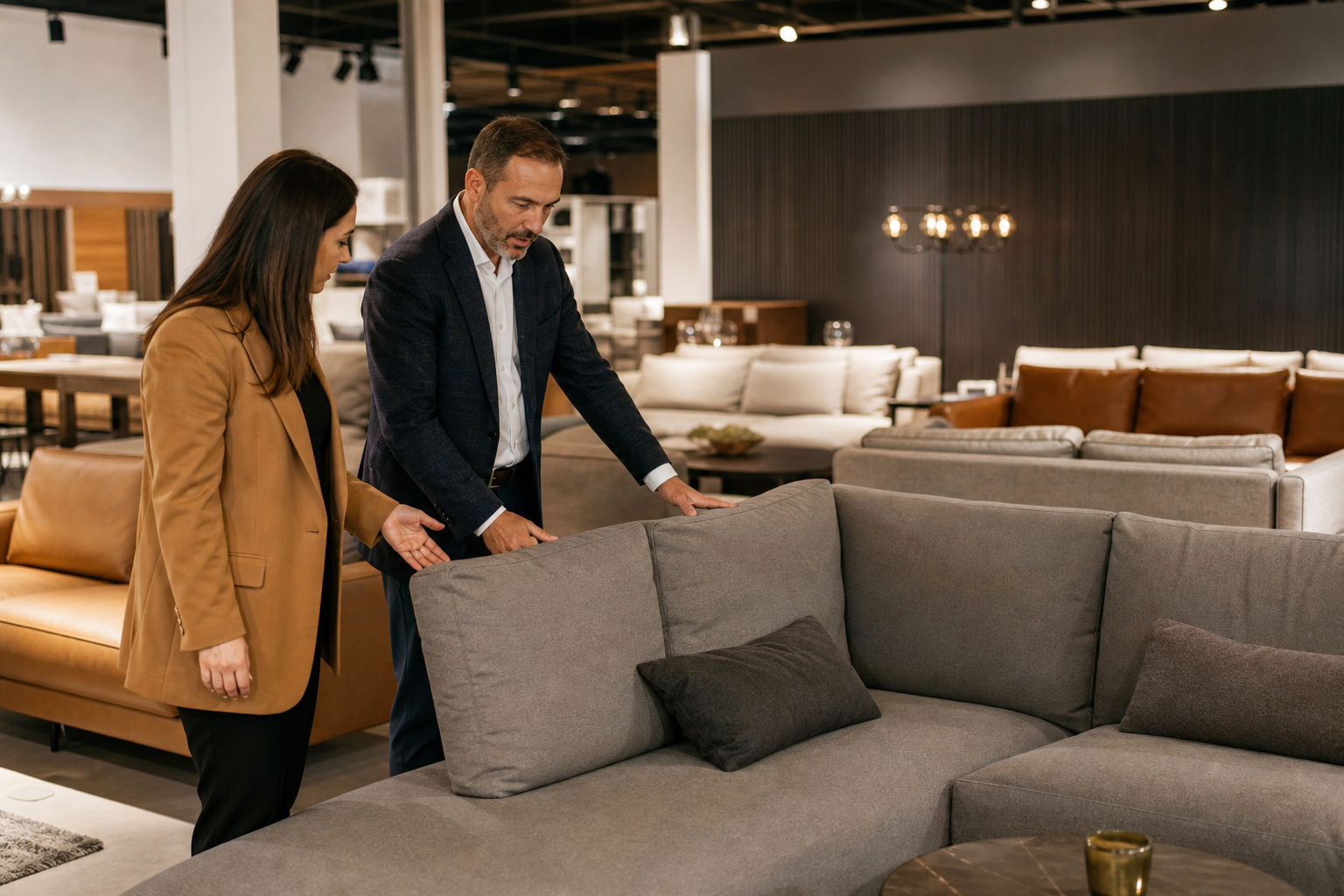
A practical framework for deciding how much space a slow-selling sofa should keep
1) Define the decision window and measurable signals
- Pick a reasonable evaluation period (8–12 weeks is a practical starting point for a sofa). Too short and you miss seasonal traffic; too long and you leak opportunity cost.
- Track specific signals: weekly showroom views of the sofa, number of trials/sits, quote/inquiry rate, conversion to sale, and revenue per square meter. Combine qualitative feedback from staff and customers (fit, comfort, perceived value) with the quantitative metrics.
2) Set thresholds tied to opportunity cost
- Establish simple benchmarks. For example: at least X inquiries per month, or conversion rate within Y% of similar sofas, or revenue-per-sqm above a baseline. If the sofa misses thresholds consistently, it’s a candidate to reallocate.
- Translate these thresholds into a visible alternative: what would a better use of that space look like? If another product could reasonably deliver 1.5x the revenue per sqm or a higher margin, that’s your opportunity cost comparison.
3) Reduce downside before you pull the trigger
- Use flexible purchases, consignment, or smaller initial buys where possible to limit tied-up cash.
- Rotate displays: swap the sample with a different sofa for a short pilot and compare the signals. Time-staggered pilots across multiple stores give comparative evidence without requiring duplicate inventory.
4) Use StarbornHub to create earlier, lighter tests
- StarbornHub’s platform-led cooperation backed by real factory capability helps you surface customer response before a full purchase. Instead of committing to large inventory, you can get early market signals from multiple retailers where the product is displayed or promoted.
- Those signals — walk-bys, sits, inquiries, local quote requests — are actionable. They don’t prove a product is perfect everywhere, but they let you see whether a product is worth a larger bet in your store.
5) Factor in local differences
- Don’t assume a sofa that performs in another city will do the same in your market. Compare local demographic and competitive context. Use StarbornHub’s cross-store signal reports to spot where and why performance diverges.
- For multi-store groups, allow each store to make slightly different decisions based on local signals rather than impose a one-size-fits-all display plan.
6) Make learning explicit
- Document the test conditions (display location, signage, price, salesperson messaging, nearby items). When a sofa underperforms, you’ll know whether the problem was the product or the setup.
- If you pull the sofa, replace it with a prioritized alternative and measure the delta. The cost of experimentation shrinks when you consciously compare what replaced the slow SKU.
Concrete rules of thumb
- Minimum test length: 8–12 weeks in stable traffic conditions.
- If a sofa produces fewer than 2 meaningful sales signals per week (sits + inquiries) in an average store, treat it as low information and consider replacing it with a test SKU.
- Always calculate revenue-per-sqm and margin-per-sqm as the primary economic metric, not raw item sales. A compact high-margin chair can beat a big slow sofa in economic value.
- Use consignment or limited buys when introducing many new sofas to avoid tying too much cash to uncertain SKUs.
Why this is different from “just move what’s slow”
Deciding to move a slow sofa isn’t just an aesthetic or stock-clearing choice; it’s a resource allocation decision. You’re exchanging visibility, sales staff focus, and cash for something else. Doing that using structured local signals — rather than gut or one-off sales — turns a reactive move into a strategic reallocation.
A final practical checklist
- Set the evaluation window and choose your signals (views, sits, inquiries, conversions).
- Put thresholds in place and calculate revenue/margin per sqm for comparison.
- Use smaller buys, consignment, or rotation to limit cash exposure.
- Run staggered pilots and compare local signals across stores.
- Use StarbornHub to get early customer-response data from a broader set of retailers before committing big purchases.
- Document setup and changes so future decisions get better faster.

Bottom line: there is no perfect, universal number of square meters a slow sofa “should” keep. The right answer depends on the signals you collect, the alternatives you can bring in, and the cash you must protect. Make the invisible visible by measuring customer behavior, running short pilots, and using network signals (like those StarbornHub provides) to reduce the guesswork before you commit your showroom and your cash.
Conclusion
StarbornHub treats local customer response as a practical buying signal, not as decoration after the buying decision is already made. For an independent furniture retailer, the point is not to accept a new supplier claim blindly. The point is to make the next product decision clearer before cash, showroom space, and customer trust are already committed.
More articles in this content module
Module: Showroom Space And Opportunity Cost
This is the full reading map for the current content block, so you can follow the logic inside this topic before jumping to another issue.
Other content modules you may want to explore
If your concern is not only this one issue, these modules open nearby paths in the StarbornHub theory system.
What it may take, cost, or risk: A decision concern about work, cost, risk, staff burden, or what the retailer might lose.
Validation And Small-Batch Testing
What should be validated before a larger stock commitment?
First reading in this module: Should furniture retailers buy stock before testing customer demand?
Why this path may be worth testing: A trust-building or low-commitment validation question.
Supplier Trust And Quality Responsibility
What incentive does the supplier have to protect quality after the first order?
First reading in this module: What should a furniture retailer ask before trusting a new sofa supplier?